

Preflop bet sizing
Preflop bet sizing has changed a lot over the years. Before solvers, many players used much larger raise sizes by default. Modern strategy usually…
Preflop
hand categories
Poker starting hands are the foundation of winning poker. Before you learn advanced bluffs or tricky river plays, you need a clear idea of which hands are strong preflop and why.
This article teaches a simple way to think about poker starting hands by grouping them into categories. It is a fast way for beginners to get started and avoid common mistakes.
To become even somewhat decent at poker you will still need to learn preflop ranges by position and situation. The purpose here is mainly to help you understand why some starting hands are better than others, so preflop ranges make more sense later.

Poker starting hands get most of their value from a few basic qualities.
If a hand has several of these qualities it is a stronger hand. If a hand has none of these qualities, it will often be weak and hard to play after the flop.
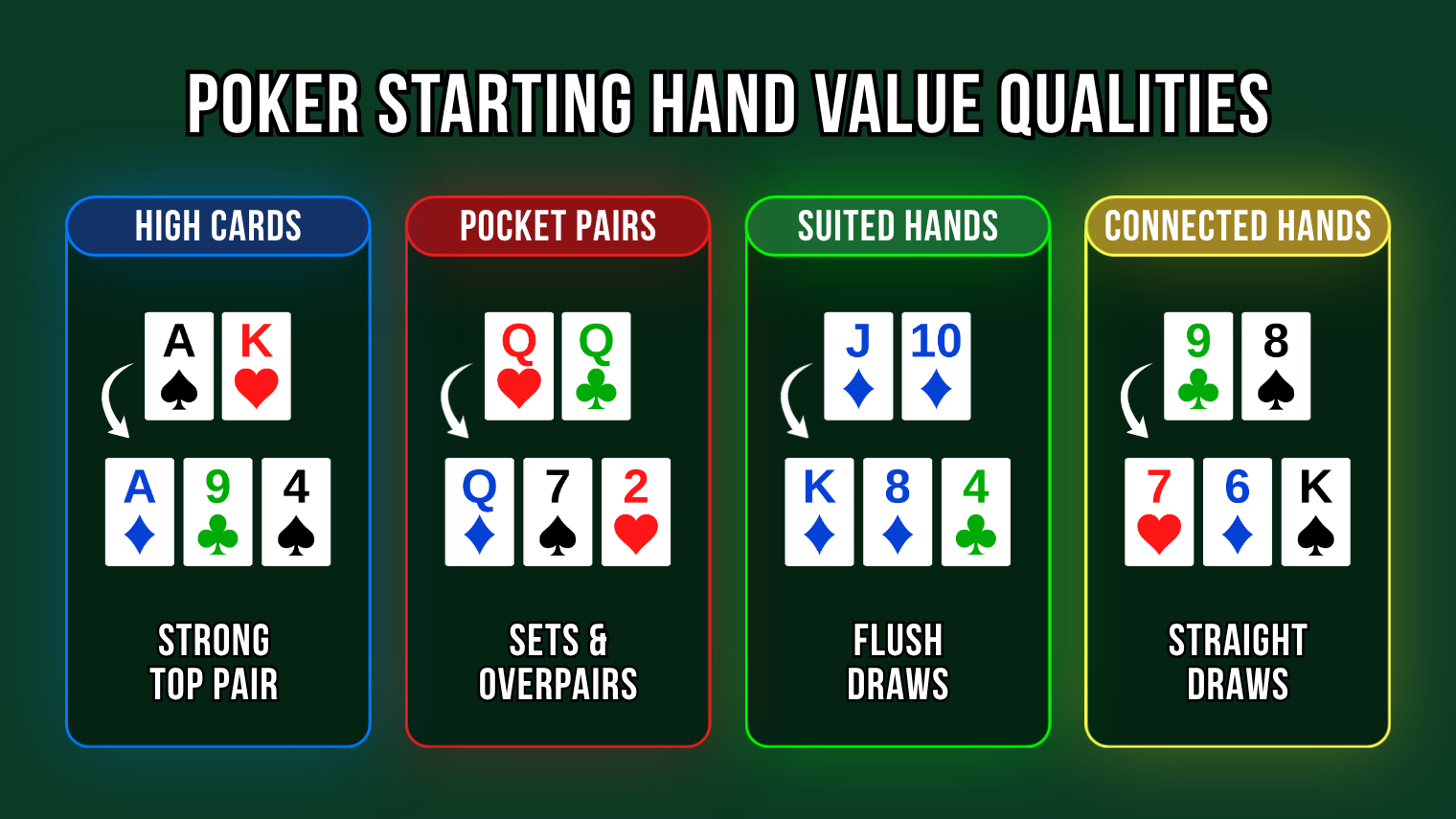
Here are five practical categories for poker starting hands.
These categories are not exact charts. They are training wheels. They help you choose better hands while you learn position, preflop ranges and postflop basics.
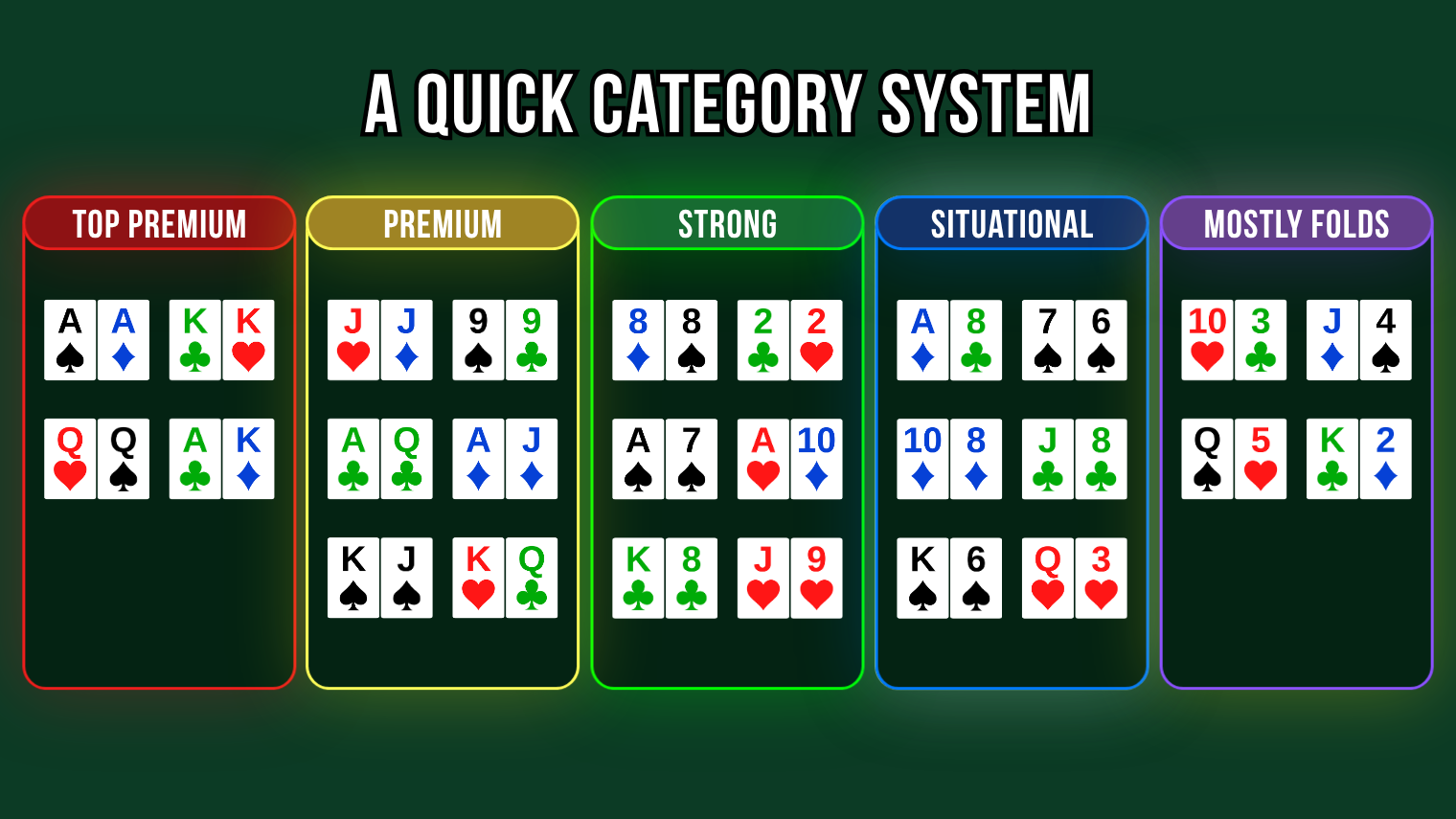
We use hand notation as a short way to write poker starting hands.
When you see a dash, it means a range of hands.
A plus sign means “and better” within the same pattern.
Top premium hands are the easiest strong hands to play. They win a lot before the flop and they often stay strong across many flops.
Examples:
Beginner advice:
Open-raise with top premium hands from any position. 3-bet when someone opens before you in most common situations.
A common beginner mistake is to slow play these hands preflop and let many players see a flop cheaply. You usually win more by building the pot early.
Premium hands are very strong, but they are slightly more sensitive to position and opponent.
Examples:
Beginner advice:
Open-raise with premium hands from any position.
Most of them can 3-bet most of the time, except against early positions at a 9-max cash table. In an MTT, you might prefer calling a raise over 3-betting. In BB these hands are mostly a call, but we can 3-bet some of them against late position raises.
If you face a 3-bet, you can often continue, but it depends on positions and how tight your opponent is. As a general tendency, suited hands call more often and offsuit hands 4-bet more often.
These hands often make strong one-pair hands. That is good, but it is not unbeatable, especially in multiway pots.
Strong hands are profitable starting hands that benefit a lot from position and good planning. Many of them win by making top pair with decent kickers, strong draws or disguised hands.
Examples:
Beginner advice:
Open most of these strong hands at an early position at a 9-max table and all of them at later positions.
Versus an open raise in a cash game, you fold most of the time against early positions at 9-max and you continue with a raise most of the time against later positions. BB is mostly a call against a raise with these hands.
Small pocket pairs are mainly about flopping a set, so they are much better when stacks are deep and you can win a big pot when you hit.
These hands teach a key concept. Suitedness and connectedness matter because they create more ways to win pots postflop.
Situational hands can be profitable, but they usually need the right conditions. This is where many beginner leaks happen.
Examples:
Beginner advice:
Play these situational hands mostly in a late position, especially when stacks are deeper. Most of these hands can call most of the time in BB against later position raises.
Mostly folds are hands that rarely make strong combinations and are difficult to play well. They have poor playability and often lose money even if they look suited or connected in a weak way.
Examples:
Beginner advice:
Default to folding these hands, unless you are in BB in an MTT against a late position raise, then some of them can call.
You might see advanced players open some borderline hands on the button in specific games. As a beginner, you should keep it simple and fold most of them.
Folding more preflop is one of the fastest ways to stop bleeding money.
Poker starting hands change value with stack depth.
With short stacks, raw equity matters more. Many hands become simpler to play because decisions are closer to all-in or fold. High cards and strong pairs gain value because you can often get the money in while you are ahead.
With deep stacks, playability matters more. Hands that can make strong draws and hidden hands gain value, because you can win bigger pots when you hit. This is where suited connectors and small pocket pairs become more attractive.
Small pairs and suited connectors often miss the flop, but when they hit big, they can win a large pot from a stronger one-pair hand.
A strong preflop hand is a good start, not a guarantee.
After the flop, everything can change. Your premium pair is often just one pair. One pair is not a monster in poker, especially when the board is connected or when multiple players are in the pot.
A common beginner leak is to overvalue hands like AA or AK after the flop and keep paying off large bets on bad runouts. Instead, you should always re-evaluate based on board texture and the action.
If the board and the betting suggest you are behind, folding can be the best play, even with a hand that was top premium preflop.
This category approach is a shortcut to help you start strong. It explains why some poker starting hands are better than others and helps you avoid obvious mistakes.
To become a solid player, you need to learn real preflop ranges. Ranges show which hands to open, call, and 3-bet based on position, stack depth, and previous action.
If you want to take the next step, you can research preflop ranges in the Range Viewer.
The fastest way to improve is active practice with feedback.
Then use the Range Viewer to study how ranges change by position and action. This helps you move from simple categories to correct preflop strategy.
Preflop bet sizing has changed a lot over the years. Before solvers, many players used much larger raise sizes by default. Modern strategy usually…

Limping in poker means entering the pot by calling the big blind instead of raising. If you are first to act and you just call, that is an open limp…