
Learn to play poker
Poker is easy to start, but hard to learn in the right order. Many beginners jump straight into playing, then get stuck. They lose, feel confused…
Poker
odds explained
Poker odds can feel intimidating at first. For many players, math is the part of poker they want to avoid. But poker odds are not really about being good at math. They are about making better decisions.
If you understand poker odds, you can answer important questions much more clearly. Should you call with a flush draw? Should you call on the river with a bluff-catcher? Should you bluff if you think your opponent folds often enough? These are all odds questions, even if they do not always feel that way.
A lot of players get taught poker odds in a way that is too mechanical. They are told to compare their draw to the pot odds and then make a decision. Sometimes that works. But often it is too simple. On the flop and turn, future betting still matters. You may win more money if you improve, fail to realize all your equity, or even win without improving. So a modern understanding of poker odds needs to include more than just the immediate price.
The good news is that you do not need advanced math to use odds well. You just need a few simple ideas and enough practice that the common patterns become familiar.
Poker odds are just a way to describe chance. Probability tells you how often something happens. Odds compare how often it happens to how often it does not happen.
At the table, most players find it easier to think in percentages than in ratios. That is completely fine. In practice, break-even percentage is usually the most useful way to think about poker odds. If you know that a call needs to work 25% of the time, that is easier to use quickly than saying you are getting 3:1.
So the key idea is simple:
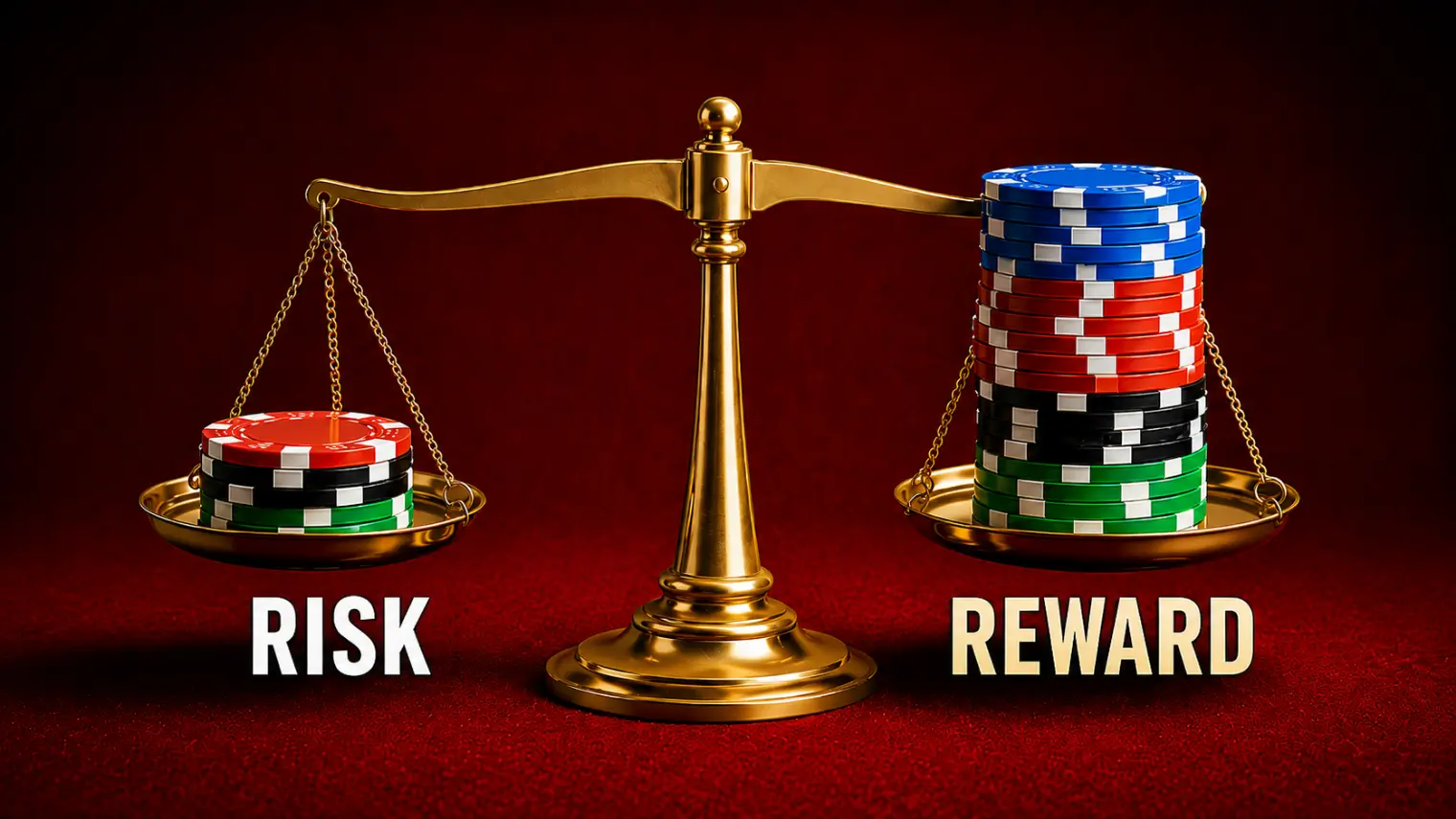
Poker odds help you compare what you risk to what you can win.
Pot odds tell you how good the immediate price is on a call. They compare how much you must call to how much you can win if you call.
A very useful formula is:
Break-even % = amount to call / final pot if you call
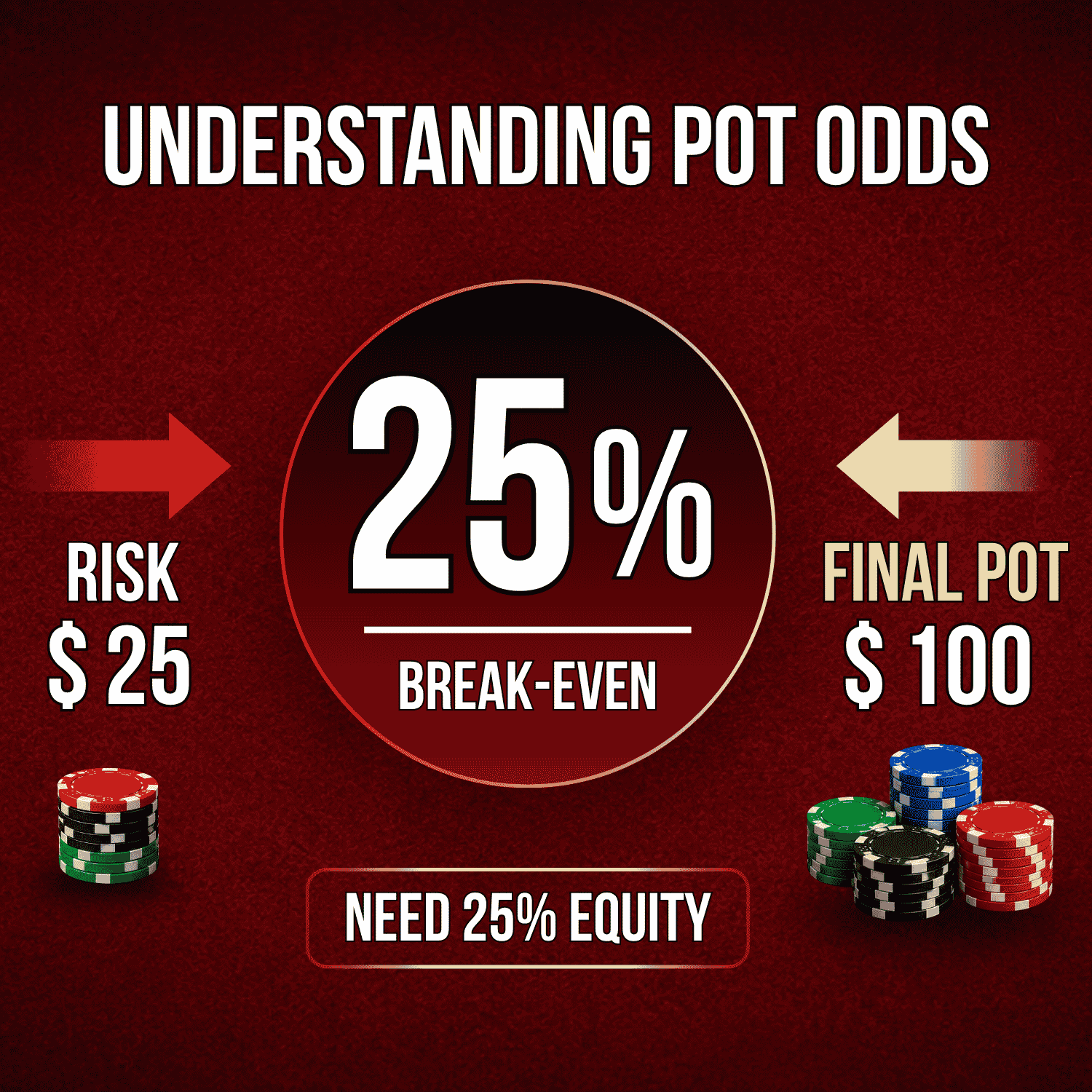
Suppose there is $50 in the pot and Villain bets $25.
If you call, the final pot will be $100.
Since it costs you $25 to try to win that $100 pot, your break-even percentage is 25%.
That means you need to win more than one time in four for the call to be profitable.
This is one of the most important ideas in poker. If you can work out your break-even percentage, you already have a strong foundation.
These are worth learning because they come up all the time. If you only memorize a few numbers, start with these.
| Bet size | Required equity to call |
|---|---|
|
33% pot |
20% |
|
50% pot |
25% |
|
75% pot |
30% |
|
100% pot |
33.3% |
|
150% pot |
37.5% |
Pot odds are most useful in spots where the hand is already close to finished. That usually means river calls and all-in situations. In those spots, there are no more future decisions after the call. The math is clean.
If there is $50 in the pot and Villain bets $30 on the river, it costs you $30 to win a final pot of $110. Your break-even percentage is about 27%.
So the question becomes very simple: am I good more than 27% of the time?
That is why pot odds are especially powerful on the river. They turn a vague question into a very practical one.
This is where many players get confused.
A common beginner thought is: “I have a draw, so I compare my chance of hitting to the pot odds, and that tells me what to do.” That is only partly true.
On the flop and turn, pot odds are only the starting point. Your hand can still make money in several ways. You may improve. You may bluff later. You may hit a pair that turns out to be good. You may also fail to realize all your equity because the hand becomes difficult to play on future streets.
So on earlier streets, pot odds tell you the immediate price, but they do not tell you the whole story. That is where implied odds and equity realization come in.
These two concepts are closely connected and it makes more sense to think about them together than as two separate boxes.
Implied odds are the extra money you expect to win later if you improve.
Equity realization is how much of your hand’s raw equity you actually turn into real winnings.
Those ideas often point in the same direction. A draw in position may realize equity well because you can see more cards, control the pot better, bluff later and get paid when you improve. A weak draw out of position may realize equity badly because you face more pressure, get forced off your hand more often and do not get paid enough when you hit.
That is why current strategy writing treats naive pot odds as only part of the answer when future betting remains. The same hand class in a strong range realizes equity better than in a weak range.
So instead of thinking of implied odds and equity realization as separate ideas, it is better to combine them into one practical question:
How much of my hand’s equity is likely to turn into money?
If the answer is “a lot,” calling becomes better. If the answer is “not much,” calling becomes worse.
There is $100 in the pot and Villain bets $50. Your break-even percentage is 25%.
If you only count the flush, you have 9 outs with one card to come. Using the common shortcut, that is about 18%. So a pure pot-odds comparison says fold.
And that is useful. But it is not automatically the whole answer.
Maybe Villain sometimes bluffs and you already win a small part of the time. Maybe a club gets paid. Maybe your hand works as a raise because you can make Villain fold better hands now.
On the other hand, maybe Villain shuts down when the flush comes and you never get paid. Maybe you are out of position and realize your equity badly.
The lesson is not that this hand is always a call or always a fold. As mentioned, pot odds are most useful when they end the action.
An out is a card that improves your hand enough that you expect to win.
If you have a flush draw, you usually have 9 outs. If you have an open-ended straight draw, you usually have 8 outs. A gutshot usually has 4 outs.
A useful shortcut is the rule of 2 and 4. With one card to come, multiply your outs by 2. With two cards to come, multiply your outs by 4.
That means a 9-out flush draw has about 18% with one card to come and about 36% with two cards to come. An 8-out straight draw has about 16% with one card to come and about 32% with two cards to come.
This is not exact, but it is very useful in real games.
| Draw type | Outs | One card to come | Two cards to come |
|---|---|---|---|
|
Gutshot straight draw |
4 |
9% |
16% |
|
Two overcards |
6 |
13% |
24% |
|
Open-ended straight draw |
8 |
17% |
32% |
|
Flush draw |
9 |
20% |
35% |
|
Straight + Flush |
15 |
33% |
54% |
The important warning is that not all outs are always clean. Sometimes your flush is not the nut flush. Sometimes a straight card also improves your opponent. Sometimes an overcard gives you a pair that still loses often enough that it should not be treated as a full out. So outs are best used as an estimate, not a perfect truth.
There is $30 in the pot and Villain goes all-in for $20. That means it costs you $20 to win a final pot of $70, so your break-even percentage is about 29%.
A flush draw with 9 outs has about 36% with two cards to come using the rule of 4. That is comfortably above the 29% you need, so this is a profitable call if your flush outs are clean.
This is a classic pot-odds spot because the all-in removes future decisions and makes the math much cleaner.
The reason is that bluffing uses the exact same risk versus reward idea. If you bluff $50 to try to win $100, your bluff needs to work often enough to break even.
The formula is:
Bluff break-even % = risk / (risk + reward)
So if you risk $50 to win $100, your bluff needs to work 33% of the time.
This is the same core logic as pot odds. You are still comparing what you risk to what you can win. The only difference is that now you are asking how often your opponent folds instead of how often you win at showdown.
| Bluff size | Required folds |
|---|---|
|
33% pot |
25% |
|
50% pot |
33% |
|
75% pot |
43% |
|
100% pot |
50% |
|
150% pot |
60% |
The first big misunderstanding is treating pot odds as if they solve every draw decision. They do not. On the flop and turn, future betting, implied odds, reverse implied odds and equity realization all matter.
The second is assuming raw equity equals real profit. A hand may have enough equity on paper and still be a bad call if it realizes that equity badly.
The third is overestimating implied odds. Players often imagine the best-case future payoff instead of the average one. That makes too many draws look playable.
The fourth is counting all outs as clean. That is one reason poker probability feels easier in theory than at the table.
In practice, most good players are not calculating pot odds and probabilities on every street. Modern poker strategy is built around studying ranges and gameplans away from the table. Once you understand those patterns, many decisions become automatic.
That is also the idea behind the Postflop Gameplan in Poker Trainer. The gameplan gives you a simple default strategy for what to do in common postflop situations. It is based on the concept of streets of value, combined with solver research and population tendencies. Instead of trying to calculate everything during the hand, you follow a structured plan that works well in most situations.
The best way to learn this is through repetition. Use the Poker Simulator to practice real decision spots and build intuition for how different hands should be played across flop, turn, and river.
Odds still matter, but they are most useful when the game moves away from your default strategy. This happens often on the river, where players bluff too much or too little and call too much or too little compared to theory. In those spots, pot odds and bluff break-even percentages can help you make better calls and better bluffs.
So the practical approach looks like this:
That combination, a strong baseline strategy and simple odds-based adjustments, is how modern players handle these situations in real games.
Poker odds are not there to make poker feel complicated. They are there to stop you from guessing.
On the river, pot odds are often the clearest tool because the hand is almost finished. On the flop and turn, you still need to think about implied odds, equity realization and future bluffing opportunities.
You do not need advanced math to use odds well. You just need a simple process and enough practice that the common patterns start to feel familiar.
If you want to connect poker odds to real postflop decisions, read our articles on equity, poker hand reading, and three reasons to bet.
Poker is easy to start, but hard to learn in the right order. Many beginners jump straight into playing, then get stuck. They lose, feel confused…

Minimum defense frequency (MDF) is a concept from poker math. It describes how often you need to continue against a bet to stop your…