
Preflop 3-betting ranges
A 3-bet is a re-raise before the flop. One player opens and you raise. That is called 3-betting. If you learn one preflop…
Introduction to
poker equity
Poker equity is how often you expect to win the pot at showdown if no more betting happens. It represents your share of the pot and answers how often you win if you get to see all cards.
If you have 50% equity, you win the pot about half the time.
If you have 25% equity, you win about one time out of four.
If you have the best possible hand on the river, your equity is 100%.
If you cannot win no matter what card comes, your equity is 0%.
Most of the time, your equity is somewhere in between.
Equity is one of the most important concepts in poker because it is the foundation for good decisions.
When players talk about whether a play is good or bad in the long run, they usually refer to expected value.
Equity is one of the main inputs used to calculate expected value in poker, which describes whether a decision makes or loses money over time.
You do not need to calculate expected value at the table. What matters is understanding equity first.
A key point is that equity assumes no further betting. It only looks at what happens if all remaining cards are dealt and the hand goes to showdown. It ignores future bets, bluffs, and folds.
This makes equity a clean and simple concept. It separates card strength from betting decisions.
You have a flush draw and your opponent has a set. The Poker Trainer Odds Calculator shows that your hand has about 25% equity. This means that you will win roughly one out of four times by the river.
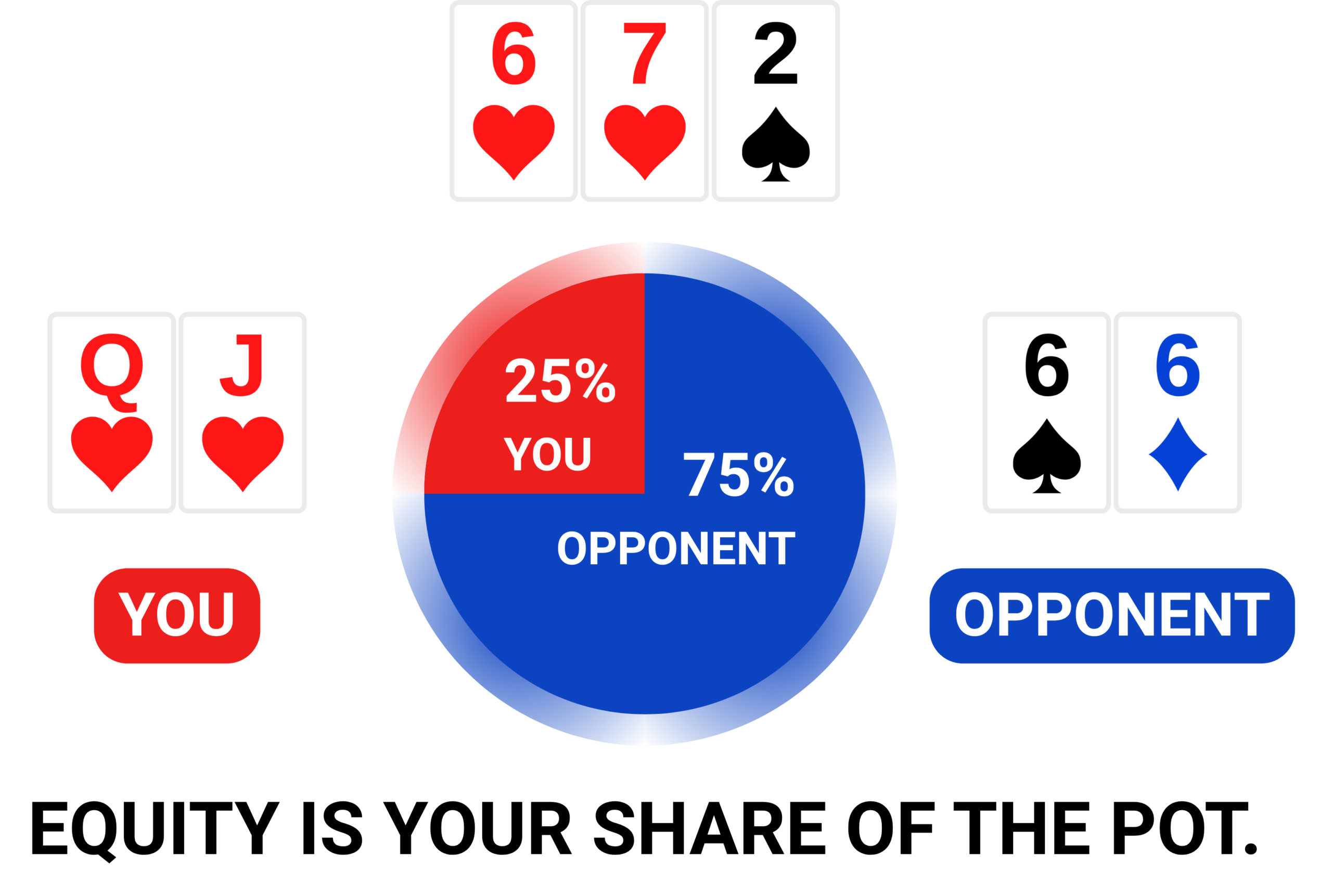
It is worth noting that your chance of making a flush is higher than 25%. Sometimes when you hit your flush, your opponent improves to a full house. Equity already accounts for this.
You can load this exact spot in the Odds Calculator and change the hero cards, opponent cards or board cards. Click calculate after each change to see how the equity updates.
In real poker, you almost never know your opponent’s exact hand. Instead, you think in ranges. A range is the set of hands your opponent could reasonably have in a given situation.
Using the same board, imagine your opponent open-raised from the lojack position. That range contains many possible hands, not just one specific holding.
Against this range, your flush draw now has about 50% equity. The cards did not change. Only your opponent’s possible hands changed. This is why equity against a range is far more important than equity against a single hand.
You can explore this by loading the same spot in the Odds Calculator and changing only the opponent’s range. Click calculate after each change to see how equity updates.
So far, we looked at equity for one hand against another hand or a range. The next step is range vs range equity. Range vs range equity compares your entire range against your opponent’s entire range.
Instead of asking how one specific hand performs, you ask how two groups of hands perform against each other. This is how strong players think about many decisions.
For example, imagine a lojack opening range versus a big blind defending range. On some boards, the lojack range performs better overall and has a clear equity advantage.
On this board, the lojack range has about 62% equity. You can load this exact spot in the Odds Calculator and then try different ranges or boards to see how the equity changes.
Range vs range equity helps explain why certain boards favor the preflop raiser and others favor the defender, even before any bets are made. This type of equity is most useful for understanding:
Range vs range equity is mainly a study tool. You would not calculate it during a hand. Instead, you use it away from the table to build intuition about how different ranges interact on different boards.
You can explore this by loading two ranges in the Odds Calculator and comparing them across different boards. Changing only the board cards often shifts the equity significantly, even when the ranges stay the same.
Understanding range vs range equity makes concepts like continuation betting, board advantage and pressure much easier to grasp.
Outs are cards that improve your hand to a likely winner on the next street.
For example, if you have a flush draw on the flop, there are usually 9 outs. These are the 9 remaining cards of your suit that complete your flush.
Outs matter on the flop and turn, when there are still cards to come. On the river there are no outs, because no more cards will be dealt.
A quick rule of thumb is the rule of 4 and 2.
Flop: Multiply your outs by 4 to estimate your chance to improve by the river.
Turn: Multiply your outs by 2 to estimate your chance to improve on the river.
This is a rule of thumb, not an exact calculation. It tends to overestimate slightly when you have many outs. Still, it is fast, easy to remember and very useful at the table.
Equity is not fixed. It changes as new cards are dealt.
On the flop, many hands have dynamic equity because two cards are still to come.
On the turn, equity becomes more stable.
On the river, equity is either 0%, 50%, or 100%, depending on whether you lose, split, or win.
This is why draws feel strong on the flop and turn, but weak on the river if they miss.
Equity tells you how often you win if the hand goes to showdown.
Equity realization describes how well a hand actually performs in practice.
A simple way to think about equity realization is playability. It measures how much of your raw equity you are able to convert into winning chips given position, betting, and future streets.
Equity realization is often written as EQR and expressed as a percentage. Hands with less than 100% EQR under-realize their equity. This often happens when a hand is hard to play, usually out of position and is forced to fold before showdown.
Hands with more than 100% EQR over-realize their equity. This happens when a hand can win the pot without showdown, for example by applying pressure with bets or raises.
Position plays a big role. Hands in position usually realize more equity because they act last. They can take free cards, control pot size, and choose better bluffs and value bets.
Strong draws often have good equity realization. A nut flush draw in position can win by improving, but it can also win when the opponent folds. Because of this, strong draws often over-realize their equity.
Range strength also matters. When your range is stronger overall, you can apply more pressure. This lowers your opponent’s equity realization and increases yours.
A simple way to think about the relationship is:
EV = Equity × EQR × Pot
You are not expected to calculate this during a hand. The formula simply shows why equity realization matters. Two hands with the same equity can lead to very different results if one realizes its equity better than the other.
High equity does not automatically mean you should put more money into the pot.
Betting decisions also depend on:
Equity is about cards. Poker decisions are about how cards and betting interact.
Equity only describes what happens if the hand goes to showdown. In real poker, many hands end before that.
Fold equity describes the chance that your opponent will fold to a bet or raise. When your opponent folds, you win the pot immediately, regardless of your cards.
Every bluff needs a certain amount of fold equity to be profitable. If your opponent folds often enough, bluffing becomes profitable even with very weak hands.
This is why some hands with low equity can still be played aggressively. Equity measures card strength. Fold equity comes from betting pressure.
You do not need to calculate exact equity during a hand. What matters is building intuition:
Once you understand poker equity, many poker decisions start to feel more logical and less emotional.
A 3-bet is a re-raise before the flop. One player opens and you raise. That is called 3-betting. If you learn one preflop…

Going all-in is the biggest moment in poker. One decision and the hand becomes high pressure right away. Either someone folds or the chips go…