Poker
0dds Calculator

What is a poker odds calculator and how does it work?

A poker odds calculator is a tool that helps you understand how often a hand will win at poker. You might also see it called a poker probability calculator or a poker equity calculator. These names all refer to the same type of tool.

Calculator on US dollar bills. Calculate poker odds.

A calculator shows your equity, which is your chance of winning if the hand is played all the way to the river and goes to showdown. Equity does not include bluffing, bet sizing or future decisions. It only answers one question: if all cards are dealt, how often does this hand win?

If your equity is 60%, that means you would win about 600 times out of 1,000 if you repeated the same situation many times and always dealt the cards to the river. Most calculators estimate this by simulating the hand many times, often 100,000 or more, to get a stable result.

Hand vs hand

There are three main ways to use an odds calculator.This is the simplest use case. You compare one exact hand against another exact hand. 

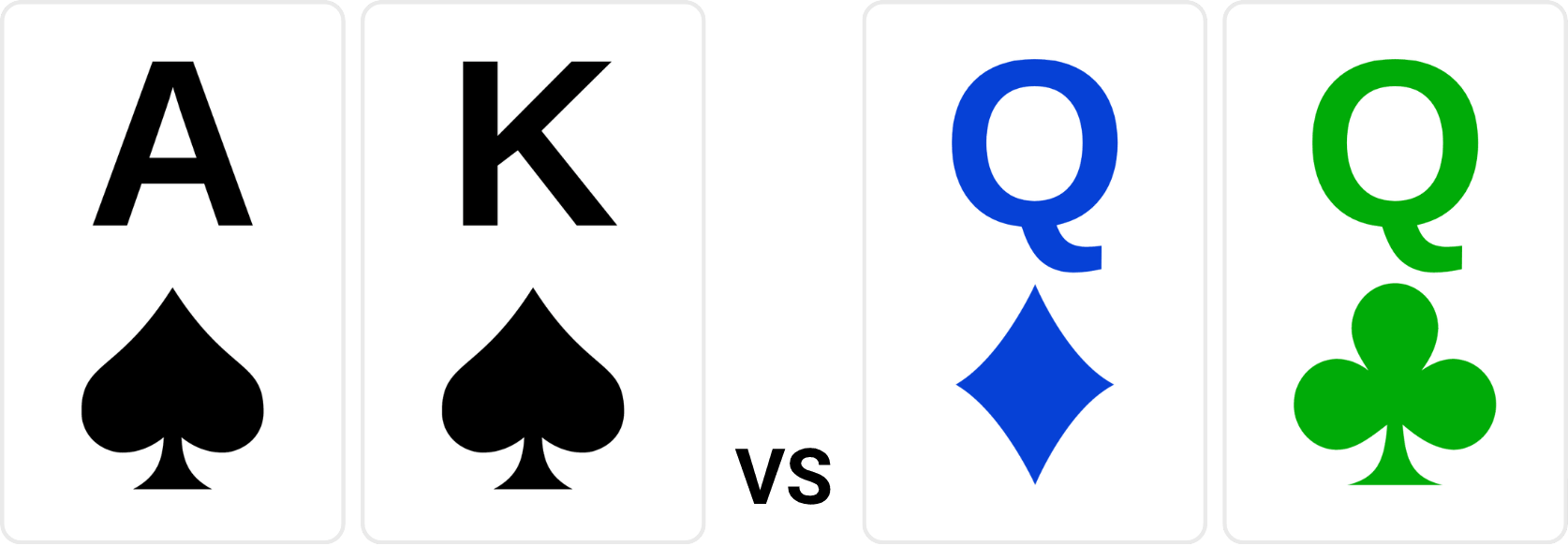
For example, compare A♠︎ K♠︎ against Q♦︎ Q♣︎ preflop. A♠︎ K♠︎ wins about 46% of the time.
Ace-king suited versus pocket queens in a poker odds calculation.

This type of calculation is useful when you are all-in and can see your opponent’s cards or when you want to build intuition for classic matchups.

You can look up this exact scenario in the Poker Trainer Odds Calculator and then change one card at a time to see what happens. Click calculate after each change to see how the equity updates. With hand vs hand calculations postflop, the Odds Calculator also shows outs.

Outs are the cards that improve your hand to a likely winner on the next street. Outs can be used on the flop and turn, when there are still cards to come. On the river there are no outs, because no more cards will be dealt.

For example, with a flush draw on the flop, the calculator shows how many cards complete your flush and how that changes your equity.

If the flop is 8♠︎ 7♠︎ 4♦, A♠︎ K♠︎ has 15 outs in this matchup.

You can load this exact spot in the Odds Calculator and see which cards count as outs.

A quick rule of thumb is the rule of 4 and 2.

Flop: Multiply your outs by 4 to estimate your chance to improve by the river.

Turn: Multiply your outs by 2 to estimate your chance to improve on the river.

This is not an exact calculation. When you have many outs it tends to overestimate a bit, but it is still a useful rough estimate and it is easy to do at the table.

Hand vs range

In real poker, you almost never know your opponent’s exact hand. Instead, you think in ranges. A range is the set of hands your opponent could reasonably have based on how they played earlier in the hand.

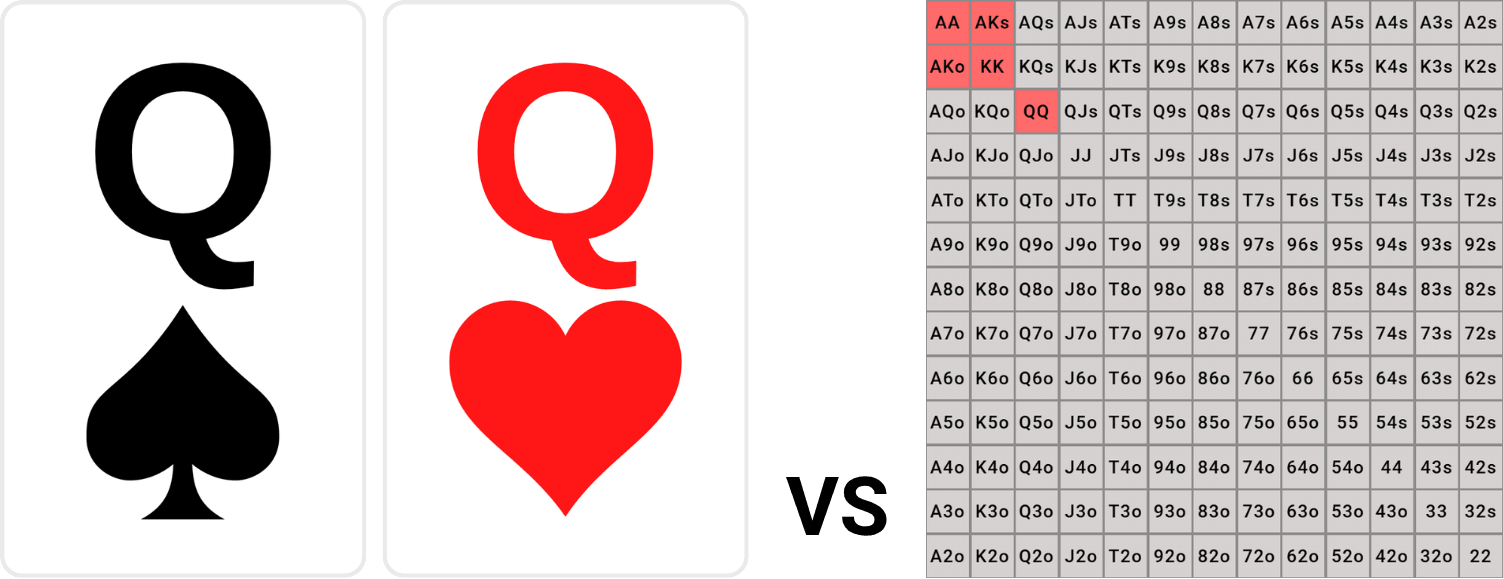
For example, imagine your opponent goes all-in preflop and you believe they would do this with AA, KK, AK and QQ.

Now you can enter your hand, for example Q♠︎ Q♥︎, and calculate your equity against that full range.
Pocket queens compared against a selected opponent hand range in a poker odds calculator.

This is more useful than hand vs hand, because it reflects real decision-making. Your equity changes because the opponent’s possible hands changed, even though your cards stayed the same.

You can look up this exact scenario in the Odds Calculator. Then try adding one hand to the opponent’s range, for example JJ, and calculate again. 

This is one of the best ways to learn what hands are strong enough to continue against tight ranges and which hands need better conditions.

Range vs range

The most advanced use case is range vs range. Here you compare your whole range against your opponent’s whole range.

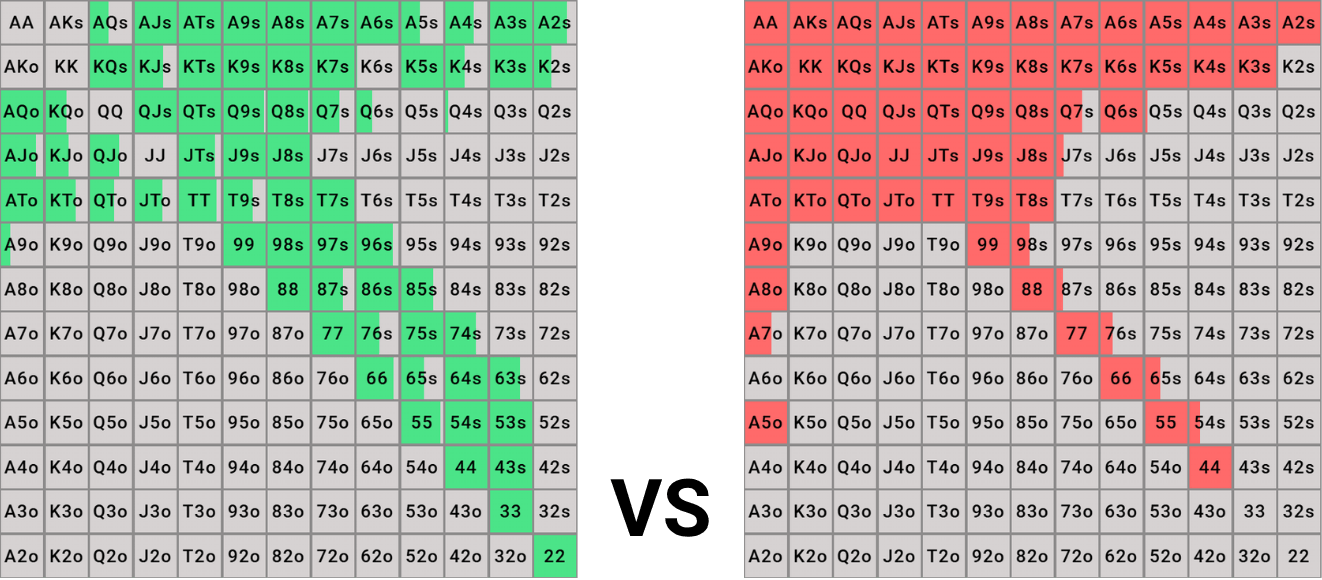
For example, you can compare a cutoff opening range against a big blind defending range. The calculator then shows how the two ranges perform against each other across many possible runouts. 

Imagine the flop is K♠︎
9♣︎ Q♥︎. It seems likely that the cutoff has a significant equity advantage here, but with how much? Look up the scenario in the Odds Calculator.

Two preflop poker hand ranges compared against each other in a poker odds calculator.

This type of calculation is mainly a study tool. You would not do it during a hand, but it is very powerful for understanding strategy.

How to use the calculator to learn faster

The real value of a poker odds calculator is not finding one answer. It is learning what changes the answer.

Try this approach. Start with a situation you care about. Look it up in the Odds Calculator so it is prefilled. Then change one thing at a time. Change your hand, change the opponent’s hand or range or change the board cards. Click calculate after each change.

Over time you will notice patterns. You will understand which draws are strong, which hands are fragile and which ranges perform well across many boards. This is how you build intuition that transfers directly to real play.

Final thoughts

A poker odds calculator, also called a poker probability calculator or poker equity calculator, is one of the best tools for learning poker away from the table.

  • Hand vs hand builds basic intuition and helps you understand outs.
  • Hand vs range teaches real decision-making.
  • Range vs range helps you understand strategy at a deeper level.

If you use it regularly, you will make faster and more confident decisions at the table.

Related content