
Learn to play poker
Poker is easy to start, but hard to learn in the right order. Many beginners jump straight into playing, then get stuck. They lose, feel confused…
Poker
hand reading
Poker hand reading means working out what hands your opponent can still have as the action unfolds. Good players do not try to guess one exact hand. They think in ranges and narrow those ranges street by street.
That is why hand reading is such an important postflop skill. If you do not know what hands your opponent can realistically have, you are mostly guessing. If you can narrow the range well, your bets, calls and folds become much clearer.
This article focuses on the basic skill itself: how to start with a preflop range, narrow it on the flop, narrow it again on the turn and make a better river decision.
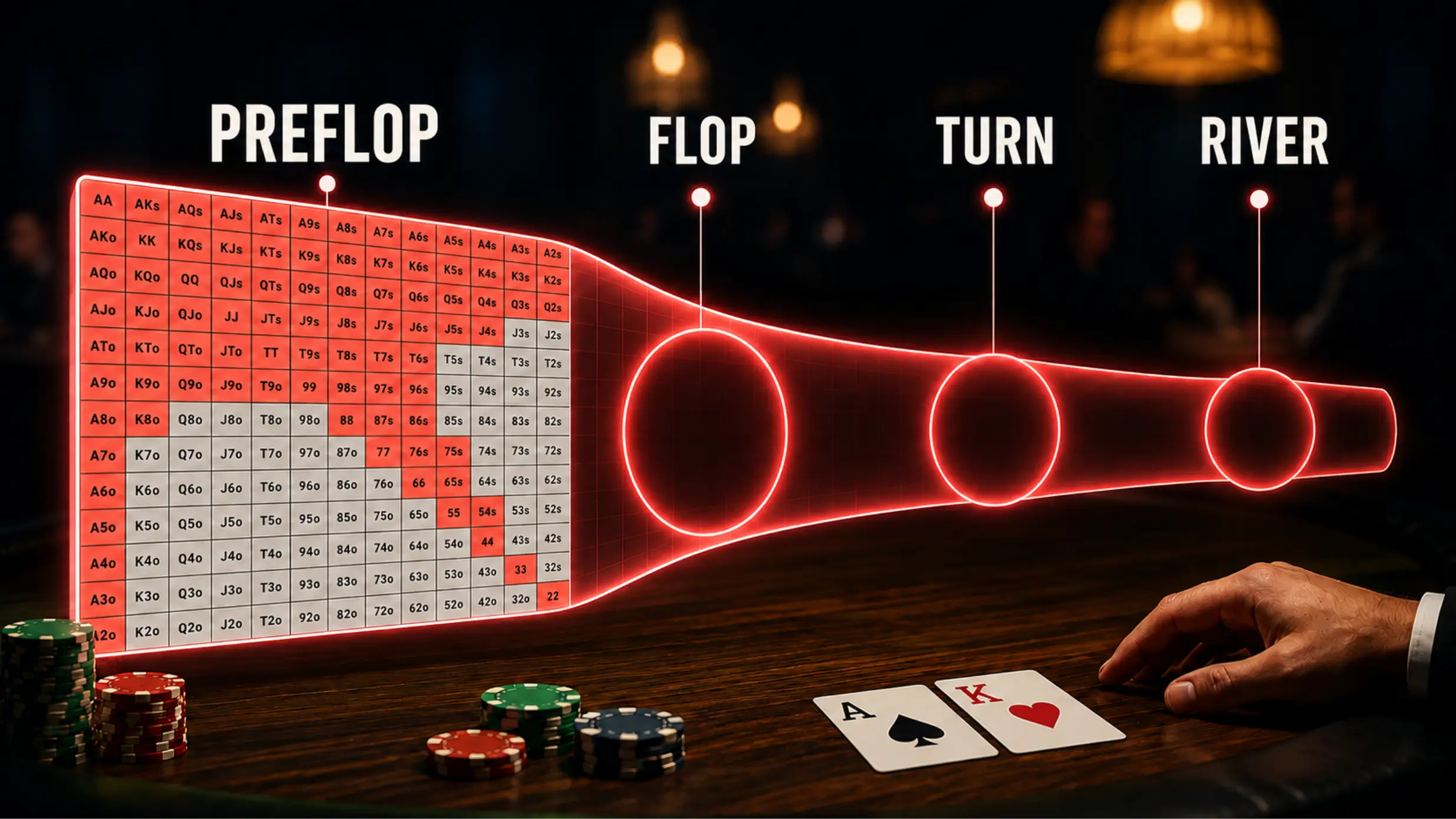
Hand reading is really range reading. Your goal is not to say, “Villain has KJ.” Your goal is to say, “Villain can have these value hands, these medium-strength hands and these draws.”
A simple way to think about it is this:
Every action removes some hands and keeps others. That is what hand reading is.
A simple beginner-friendly process is:
This is also why preflop work matters so much. If you do not understand opening ranges, calling ranges, and 3-bet ranges, postflop hand reading becomes much harder and less precise.
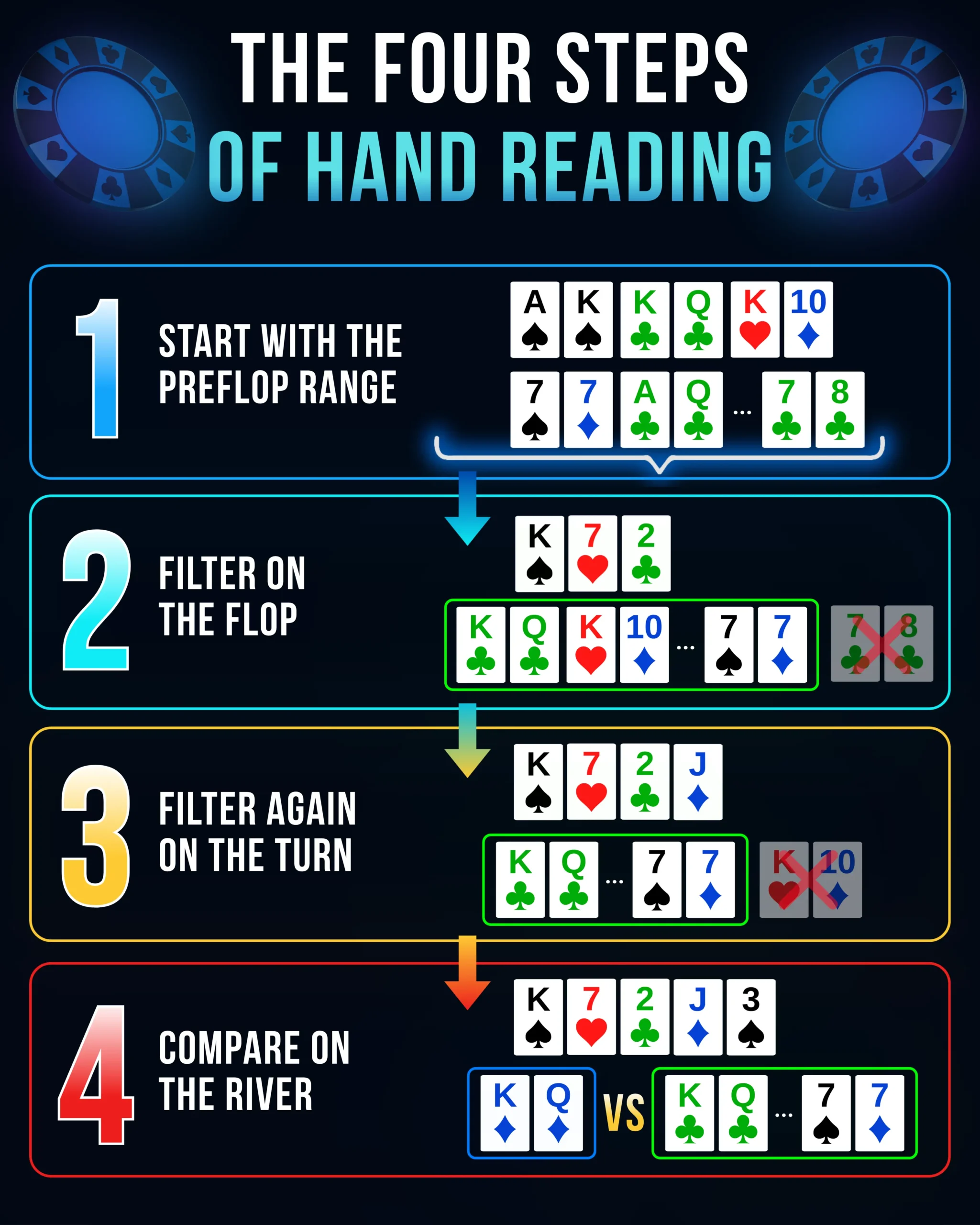
On the flop, ask: What hands hit this board well?
On the turn, ask: Which draws improved and which weak hands now give up?
On the river, ask: What value hands are left and which missed draws might bluff?
That is usually enough to make your thought process much better.
You do not need to count every combo perfectly at the table. You just need to move in the right direction. Good hand reading is about narrowing ranges logically, not magically naming exact cards.
Let us use a beginner-friendly example that goes all the way to the river.
You open to 2.5 bb from the button and the big blind calls.
Start with the preflop range. From the big blind, the caller can have many hands:
When the big blind calls the flop, some hands disappear. Very weak hands and complete misses fold. The range now contains more made hands and draws.
A reasonable estimate is that the big blind continues with:
This is where hand reading becomes more useful. The turn is mostly a blank. Because the big blind calls again, some weaker hands become less likely. Many random ace-high hands are gone already. Some weak 4x hands may now fold.
The range becomes more concentrated around:
The river is 7♣︎.
The big blind checks.
Now ask: What changed?
The river pairs the 7. That improves some hands. A hand like 7x is now trips. A hand like Q7 becomes a full house. But many hands in the range did not improve. Worse Qx is still a big part of their range and are now bluff catchers. Missed diamond draws are now just missed draws. So what does the river range look like?
Hands that beat you could include:
Worse hands that may still call (depending on bet size):
That is the key lesson. You are not deciding against one hand. You are deciding against a range made of better hands, worse hands and missed draws.
That is already useful hand reading. In practice we would need to consider more things like bet sizes and player type.
Hand reading is not only about the board and the action. It also depends on who you are playing against.
A tight player usually continues with a stronger range, so their calls and raises deserve more respect. A loose player often continues with too many weak hands, which means your value hands may be stronger than they first appear. An aggressive player may keep more bluffs in their range, while a passive player is less likely to bet without a made hand.
This means the same board and the same action can mean different things against different opponents. The better you understand player types, the more accurate your hand reading becomes.
The biggest beginner mistake is trying to put the opponent on one exact hand. That is not how strong players think. They think in groups of hands and narrow those groups with each action.
Another common mistake is forgetting that ranges get stronger when a player keeps calling. A flop call removes some weak hands. A turn call removes even more. By the river, one-pair hands that looked strong on the flop may no longer be ahead of the continuing range very often.
A third mistake is ignoring missed draws. On many rivers, missed draws are a real part of the range. If you forget them, you might overfold or underbluff.
The fastest way to improve is deliberate practice.
First, study preflop ranges. If you do not know what someone can have before the flop, the rest becomes guesswork.
Then practice asking the same simple questions:
That repeated thought process is what builds skill.
Emphasize narrowing a range over time rather than trying to “soul read” one hand.
Poker Trainer is built for exactly this kind of practice.
In the Poker Simulator, you can practice postflop situations and train yourself to think in ranges instead of single hands. That makes the skill much easier to build than by only playing regular poker hands and hoping experience will teach it.
If you already know your preflop ranges, the next step is to use the Postflop exercise in the Poker Simulator to practice narrowing your opponent’s range from street to street.
Poker hand reading is the skill of narrowing your opponent’s ranges as the hand develops. That is what makes postflop poker less like guessing and more like structured decision-making.
A very useful habit is to pause before you act and think through what Villain will likely do with different parts of their range. Which hands call? Which hands fold? Which hands raise? That one habit will improve your hand reading quickly, and it also helps you understand why you are betting in the first place. For more on that, see our guide to three reasons to bet.
Then practice it. The fastest way to build this skill is to work through hands actively in the Poker Simulator, where you can compare your guess against the likely range and result.
Poker is easy to start, but hard to learn in the right order. Many beginners jump straight into playing, then get stuck. They lose, feel confused…

Poker is hard, but it is also fun and rewarding. If you like reading, poker books can be a good complement to practice, videos, and training…