
Poker squeeze
A squeeze is a preflop 3-bet after there has been an open raise and one or more callers. It is called a squeeze because the original raiser is “squeezed”…
Facing a
raise preflop
When someone opens the pot before you, you are facing a raise. This is one of the most common preflop situations in poker.
In this spot you have three options: fold, call or 3-bet. Your choice depends mainly on your position, the opener’s position, and how well your hand plays after the flop.
This guide focuses on 6-max cash games with 100 bb effective stacks in a raked online environment. The exact ranges on this page are built for cash games, but the main principles apply in all formats. Stronger positions can defend wider, and out-of-position calling is usually harder.
If you mainly play tournaments, the ideas still help, but the ranges will be different. Antes and no rake add dead money and improve pot odds, which often leads to more calling and wider defense than in cash games. In Poker Trainer you can explore the correct ranges for your format and stack depth in the Range Viewer.
If you are not comfortable with opening ranges yet, read our guide to opening poker hands first. It helps you understand what the opener can have.
In raked 100 bb cash games, calling is less attractive than many players think. Rake reduces the profitability of small and medium pots, and calling from early and middle positions often creates difficult postflop situations.
For that reason, PTO and our GTO solutions are mostly 3-bet or fold when facing a raise from positions like HJ, CO, or SB.
Calling from these seats often invites squeezes from players behind, creates awkward multiway pots, or forces you to play out of position. It also makes the strategy much harder to learn.
As a baseline, you can think:
Most positions versus a raise → 3-bet your value hands and selected bluffs and fold the rest.
There are two important exceptions: the button and the big blind. These two seats defend differently and for different reasons.
The charts in this article are built for 6-max cash games with 100 bb effective stacks in a typical online raked environment. They are calibrated for NL50-style rake, which slightly favors tighter and more playable ranges compared to no-rake games. At higher stakes with lower rake, some marginal hands can become slightly more profitable.
The preflop sizing used for these charts is an open raise of 2.5 bb from LJ, HJ, CO, and BTN, and an open raise of 3 bb from the small blind.
Poker Trainer includes two types of ranges: PTO and GTO (game theory optimal).
GTO ranges are direct solver outputs and include mixed frequencies where the same hand may take different actions at different percentages.
PTO (Poker Trainer optimized) ranges are built from those solver outputs but simplified to use pure decisions and to be easier to learn and execute.
For most beginners and intermediate players, PTO is the best starting point. As you improve, you can explore the GTO ranges as well.
If you play with very different rake or use different raise sizes, treat these charts as a strong baseline and expect small adjustments. If you want a deeper explanation of sizing and how it affects ranges, read our guide to preflop bet sizing.
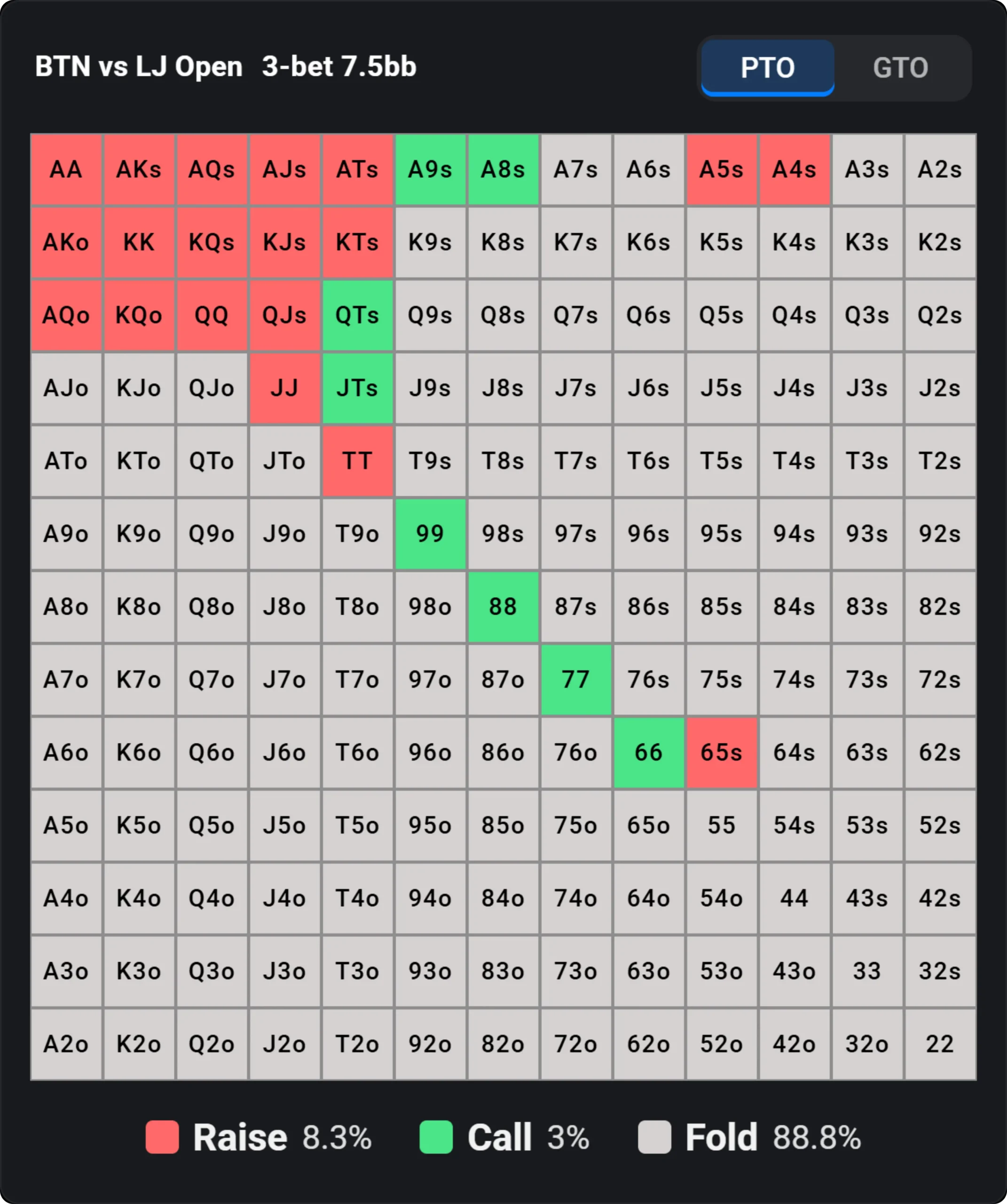
The button is the best seat in poker. When you call on the button, you guarantee position after the flop.
That positional advantage lets you realize equity better, keep the pot smaller with medium-strength hands and apply pressure on later streets. Because of this, the button often has a real calling range when facing an open, especially against early position raises.
At lower stakes, some strategies still lean toward 3-bet or fold even on the button. But compared to other seats, the button is one of the main places where calling makes sense.
In this type of spot, you will typically 3-bet your strongest hands for value, 3-bet selected hands as bluffs, call with hands that play well in position and fold the weakest offsuit hands.
If you want the full logic behind calling, read our guide to preflop calling ranges.
If you want full value and bluff construction, read the guide to preflop 3-bet ranges.
Big blind defense is completely different from button calling.
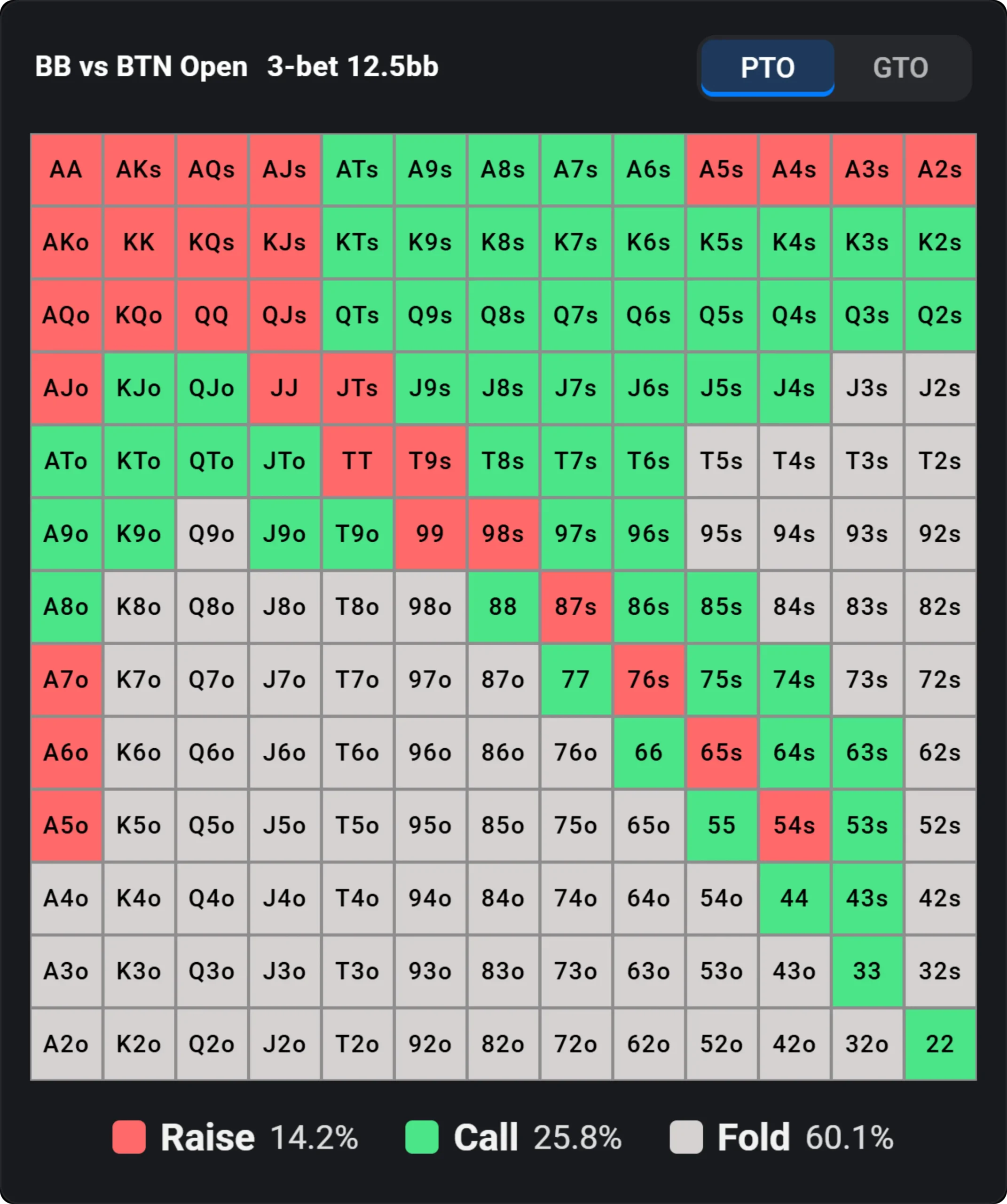
You are out of position, but you already have one big blind invested. You also close the action preflop, which means no one can squeeze behind you.
Because of that, the big blind can defend much wider than other seats. Many hands that are folds elsewhere become profitable calls in the big blind because of pot odds and closing the action.
This is one of the most common spots in poker. If you learn big blind defense well, you will face fewer tough situations and you will lose less money in the blinds.
Outside of the button and big blind, strategy is usually simpler.
When you face a raise from HJ or CO and you are not on the button or in the big blind, your range is often close to 3-bet or fold. This keeps your strategy structured, easier to execute, and less punished by rake.
If you want to explore every exact scenario, use the Range Viewer inside Poker Trainer. You can select positions and see the recommended fold, call, and 3-bet ranges.
Do not try to memorize every square in the chart. Strong players learn patterns, borders, and a few key anchor hands.
Start by studying spots in a natural order, from tight ranges to wide ranges. Begin with defending versus an LJ open, then move to HJ, then CO, then BTN and finally SB. This makes it easier to see how your defense expands as the opener gets wider.
Use hand categories to simplify the chart. Think in groups like pocket pairs, suited aces, offsuit aces, broadways, and suited connectors. Then learn the weakest hand you still defend in each group.
Focus on the border of the range. Most hands are clear folds or clear continues. The thin edge is where most mistakes happen.
In Poker Trainer, you can explore exact scenarios in the Range Viewer. Then practice the same spots in Preflop mode inside the Poker Simulator. Repetition with feedback is the fastest way to turn opening ranges into automatic decisions.
Facing a raise is one of the most frequent situations in poker. In raked 100 bb cash games, most positions are close to 3-bet or fold, while the button and big blind have meaningful calling ranges for different reasons.
Master the button and big blind first. Then build a simple, structured baseline for the other positions.
A squeeze is a preflop 3-bet after there has been an open raise and one or more callers. It is called a squeeze because the original raiser is “squeezed”…

Many players see a decent hand and they bet. They see a weak hand and they check. This often leads to decisions that are hard to explain later…