

How to get better at poker
Poker is easy to learn, but hard to master. That is part of what makes it fun. If you want to know how to become better at poker, the key is…
Opening
poker hands
Choosing the right opening poker hands is one of the fastest ways to improve your results. It helps you avoid the most common preflop mistake: playing too many hands from the wrong position.
A good poker starting hands chart gives you a clear default plan. You look at your position, find your hand on the grid and follow the recommended action.
This article focuses on opening poker hands in 6-max cash games with 100 bb effective stacks. The spot is an unopened pot, also called RFI (raise first in). The exact charts on this page are built for cash games with rake, but the main principles apply in all formats. Position matters, suited hands play better than weak offsuit hands and ranges get wider as you get closer to the button.
If you mainly play tournaments, the ideas still help, but the ranges will be different. Tournaments usually have antes and no rake taken from each pot. That adds dead money and improves pot odds, which often leads to wider defending and more calling than in cash games. In Poker Trainer you can switch formats in the Range Viewer to explore the correct ranges for your stack depth and game type.
When no one has entered the pot, you either raise or fold. Calling the big blind without raising is called limping. Open limping gives other players a cheap price and often leads to multiway pots where your edge is smaller. That is why modern poker starting hands charts are built around raise or fold decisions in unopened pots.
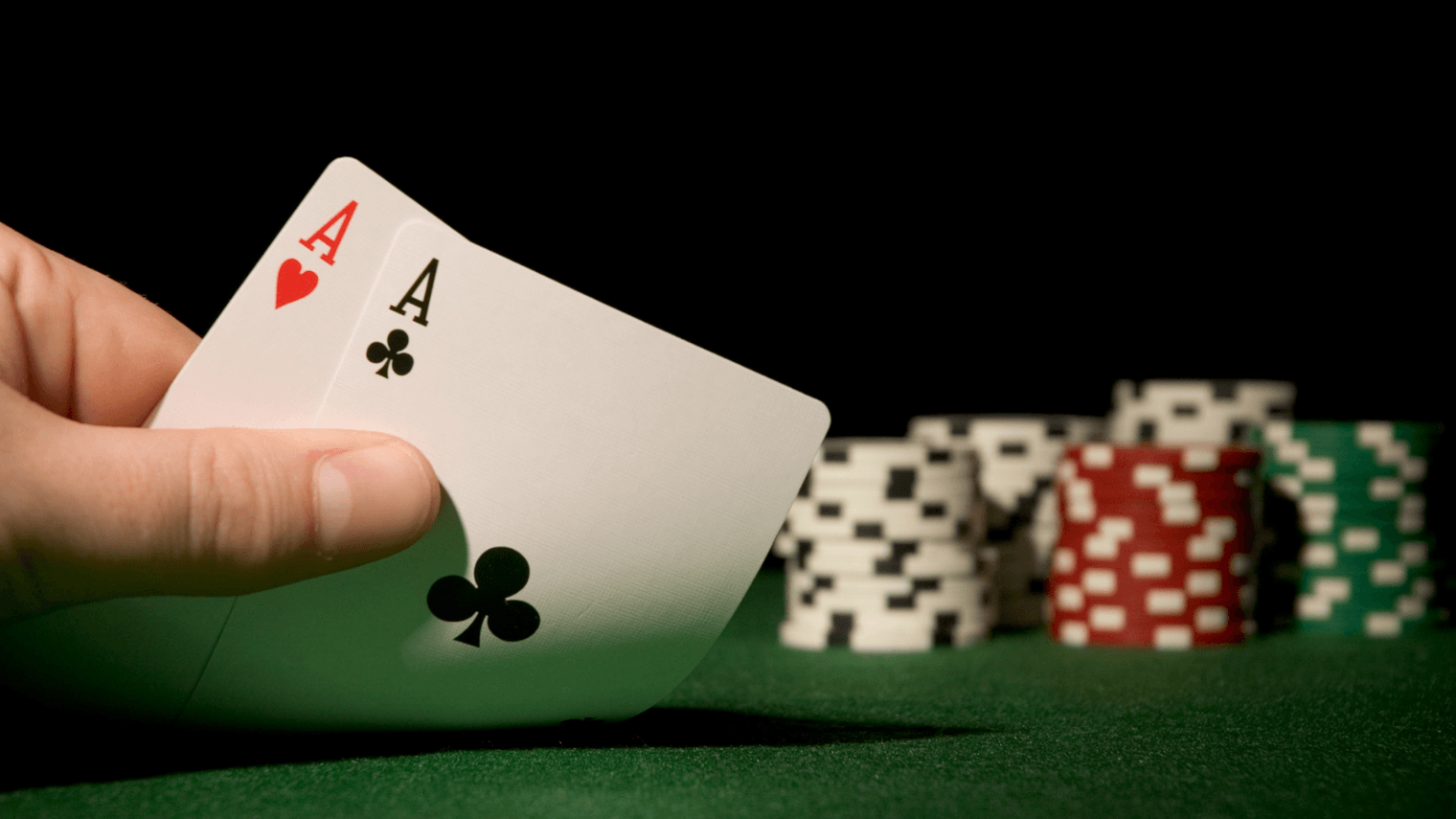
Opening poker hands are the hands you choose to play when you are first to enter the pot.
They are often shown as a poker starting hands chart. The chart is a 13×13 grid where each square is a starting hand, like AJo or 76s. Each square shows your default action, usually with colors. If you are not familiar with starting hand charts, read our guide to preflop range charts.
These charts remove guesswork. Instead of relying on feel, you follow a structured baseline. Over time, this builds discipline and consistency.
Every hand starts preflop. Your opening range affects everything that happens later.
If you open too many weak hands, you face more tough postflop spots and stronger players can attack you. If you open too tight, you miss profitable steals and become predictable. When you finally pick up a strong hand, good opponents may give you less action because your range looks too strong.
Small preflop mistakes repeat hundreds of times. That is why improving your opening poker hands is one of the highest return study topics.
If you are not familiar with what makes a good preflop starting hand, start by reading our guide to preflop hand categories.
The charts in this article are built for 6-max cash games with 100 bb effective stacks in a typical online raked environment. They are based on NL50-style rake, which slightly favors tighter and more playable ranges compared to no-rake games. At higher stakes with lower rake, some marginal hands can become slightly more profitable.
The preflop sizing used for these charts is an open raise of 2.5 bb from LJ, HJ, CO, and BTN, and an open raise of 3 bb from the small blind.
Poker Trainer includes two types of ranges: PTO and GTO (game theory optimal). GTO ranges are direct solver outputs and include mixed frequencies where the same hand may take different actions at different percentages. PTO (Poker Trainer optimized) ranges are built from those solver outputs but simplified to use pure decisions and to be easier to learn and execute. For most beginners and intermediate players, PTO is the best starting point. As you improve, you can explore the GTO ranges as well.
If you play with very different rake or use different raise sizes, treat these charts as a strong baseline and expect small adjustments. If you want a deeper explanation of sizing and how it affects ranges, read our guide to preflop bet sizing.
GTO charts are direct solver outputs. Solvers often use mixed frequencies, which means the same hand can take different actions at different percentages. Mixing can be useful in theory, but it is hard to learn and hard to execute.
You might manage mixed frequencies for opening poker hands, but once you add play versus an open raise, versus a 3-bet, and versus a 4-bet, it becomes unrealistic for most humans. More complexity also increases the chance of mistakes at the table.
PTO ranges are built from solver outputs, but optimized for ease of learning and ease of playing. PTO stays closely aligned to GTO ranges and frequencies with close to zero EV loss, but removes complicated mixing and uses mostly pure decisions.
Extensive solver comparisons show that the PTO ranges remain very close to optimal across typical online rake environments from NL2 up to NL200. The underlying GTO solutions do change as rake changes, but the PTO simplifications were carefully chosen so they remain stable across those shifts. In practice this means the same simplified ranges continue to perform very well across a wide range of stakes, even though the exact solver solutions are slightly different.
At high stakes such as NL500 and above, rake becomes even lower and the optimal GTO ranges widen slightly. In those environments a few additional marginal hands become profitable in some scenarios, which means the PTO simplification becomes slightly tighter than the theoretical optimum.
It is also important to understand how mixing works in theory. When a solver mixes a hand between actions, those actions have the same EV. Choosing one of those actions every time (a pure strategy) therefore has essentially the same EV unless an opponent specifically recognizes the simplification and adjusts to exploit it. In practice this is extremely difficult preflop, especially against a well-constructed range like PTO.
PTO cash ranges are also designed to be stable across common raise sizes. PTO 100 bb cash is cross-checked versus both 2 bb and 3 bb opens and the 3-bet hands are selected to remain stable across these sizes. This reduces how much you need to adjust when facing different open sizes.
The main exception is big blind defense, where the calling range changes more between 2 bb and 3 bb opens. For those adjustments, you can explore the exact GTO ranges in the Range Viewer (Cash → GTO).
The PTO cash range is also designed to perform well against different 3-bet sizes from the blinds. It works well against both 4x and 5x 3-bets, which makes it robust across many online environments.
For live players, PTO is also a solid baseline. It is close to optimal for live cash games with 3 bb opens at 10% rake with 2 bb cap, especially if you adjust the big blind calling range slightly.
Poker Trainer includes both PTO charts and full GTO charts. If you want maximum theoretical precision and do not mind the extra complexity, you can study and practice the GTO charts inside the app as well. For most beginners and intermediate players, PTO is the better starting point because it is much easier to learn and you will make fewer mistakes in real games.
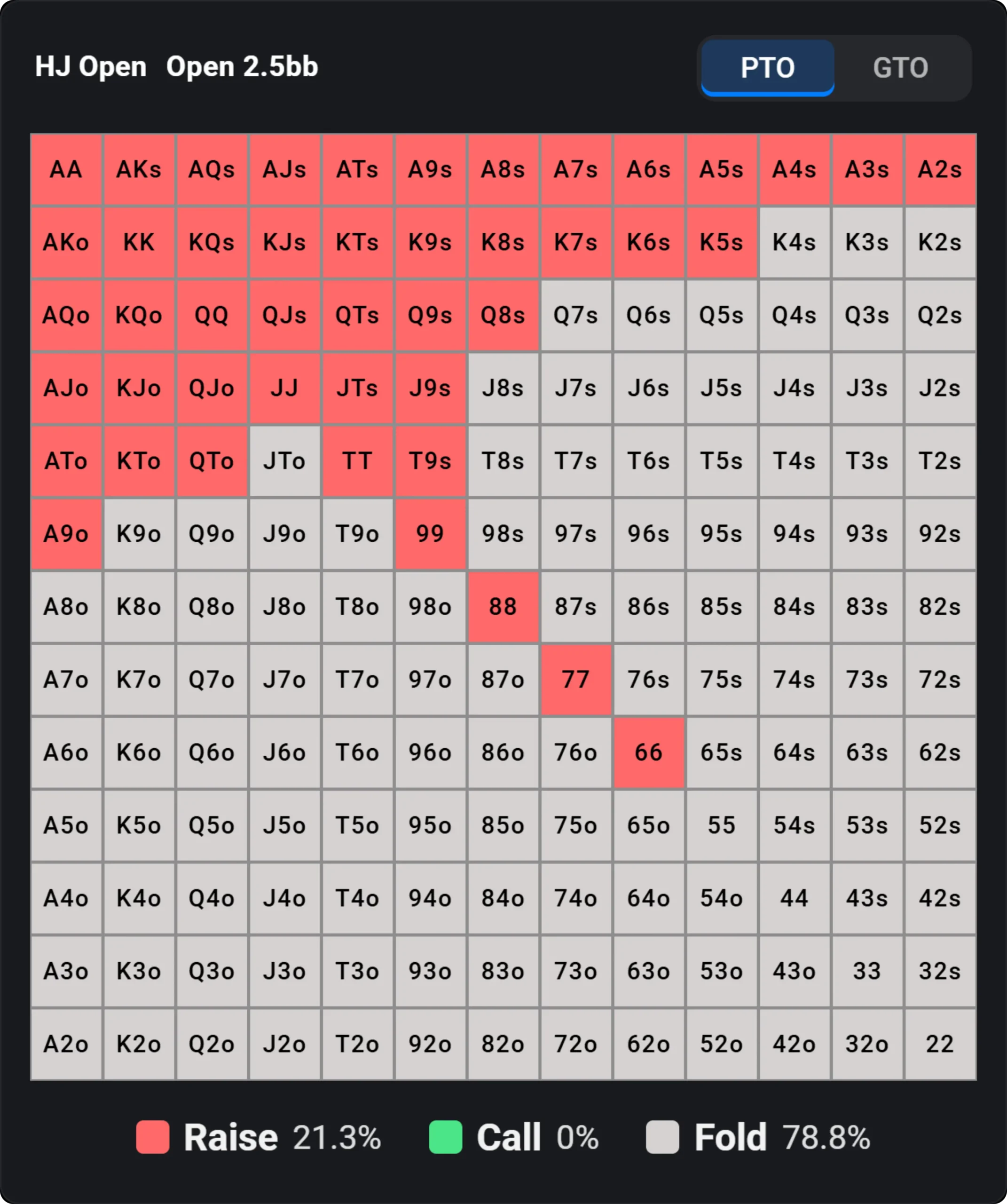
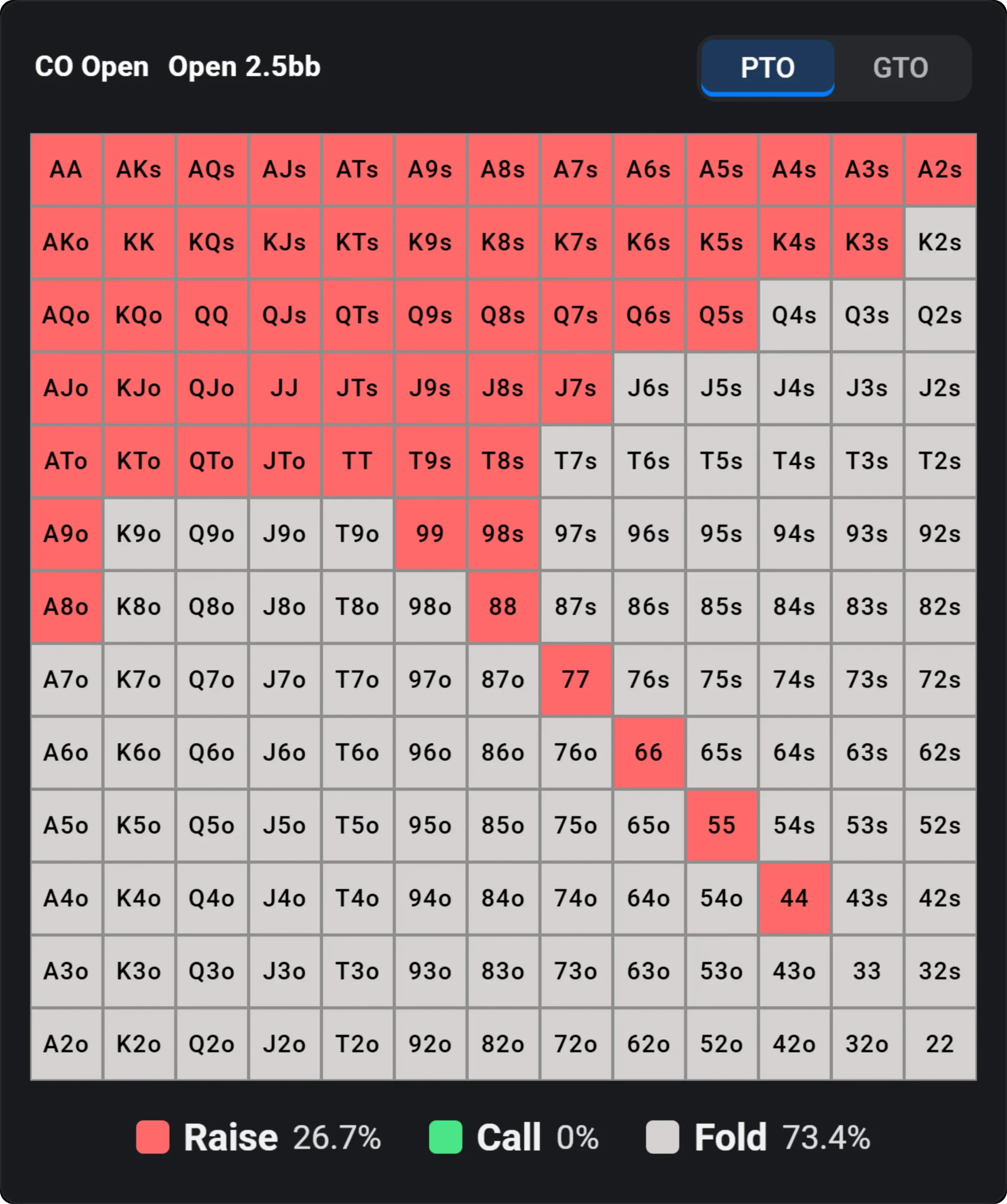
Recommended opening poker hands for each position in a 6-max cash game. Opening ranges expand as fewer players remain to act.
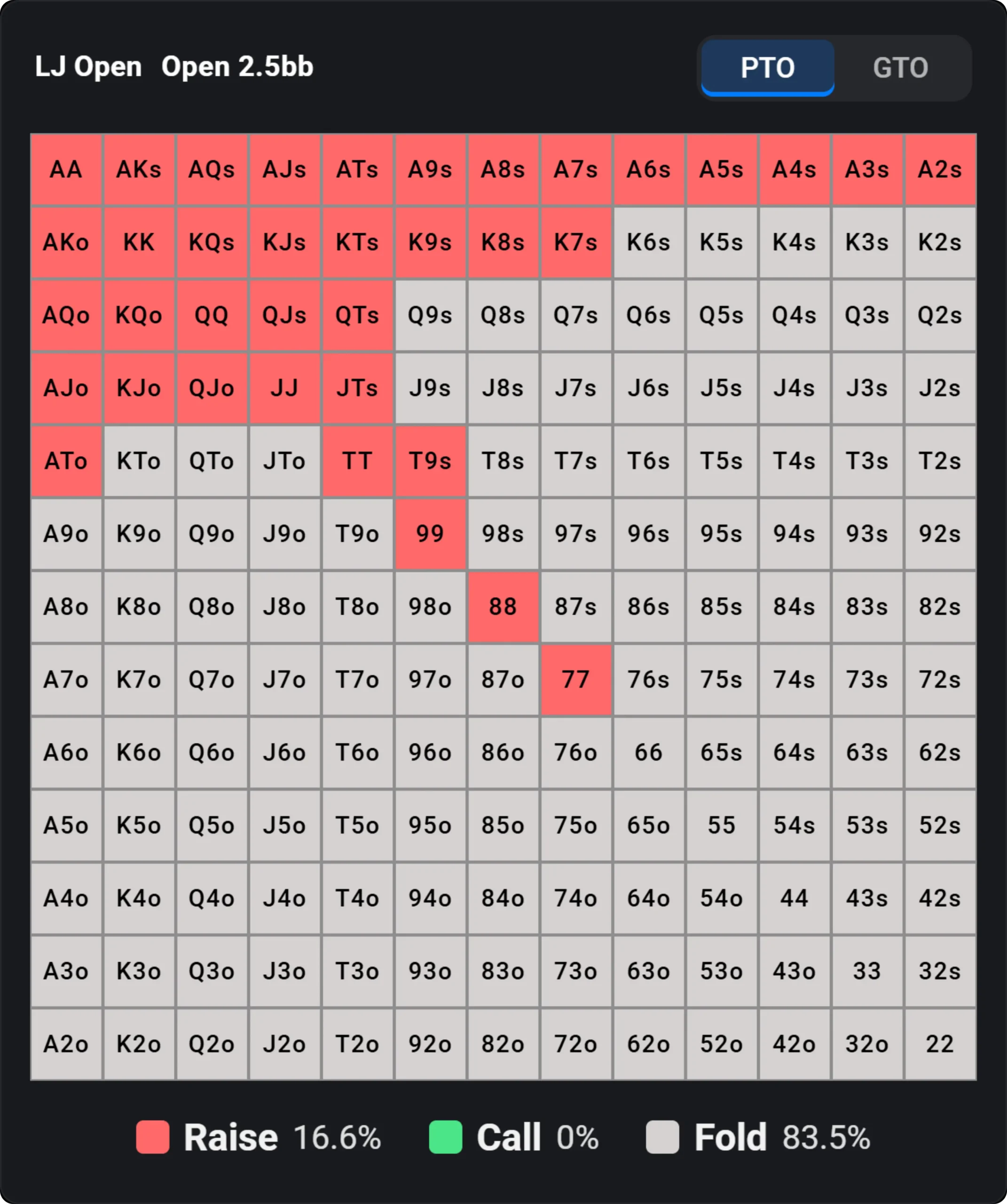
From LJ you must play relatively tight because five players still have the opportunity to enter the pot. With many players left to act, the chance that someone has a strong hand is higher.
Hands that easily make second-best pairs are usually folds. Strong broadways, suited hands that can make strong draws and pocket pairs form the core of the opening range.
This tighter structure protects you from difficult multiway pots and frequent 3-bets from the players behind you.
From HJ the range expands slightly because one fewer player remains to act behind you. With fewer players left, it becomes a bit safer to open additional hands.
Most of the expansion happens in borderline offsuit and suited hands that were just folds from LJ. However, discipline is still important because four players remain to act and strong hands can still appear behind you.
The core of the range still consists of strong broadways, suited hands and pocket pairs, but you can now profitably add a few more hands around the edge of the range.
The cutoff is where opening ranges begin to expand more clearly.
Only three players remain behind you, which significantly reduces the risk of running into a very strong hand. Because of this, you can profitably open more suited hands, weaker broadways, and additional pocket pairs.
Position also becomes a powerful advantage, which makes it easier to win pots both before and after the flop.
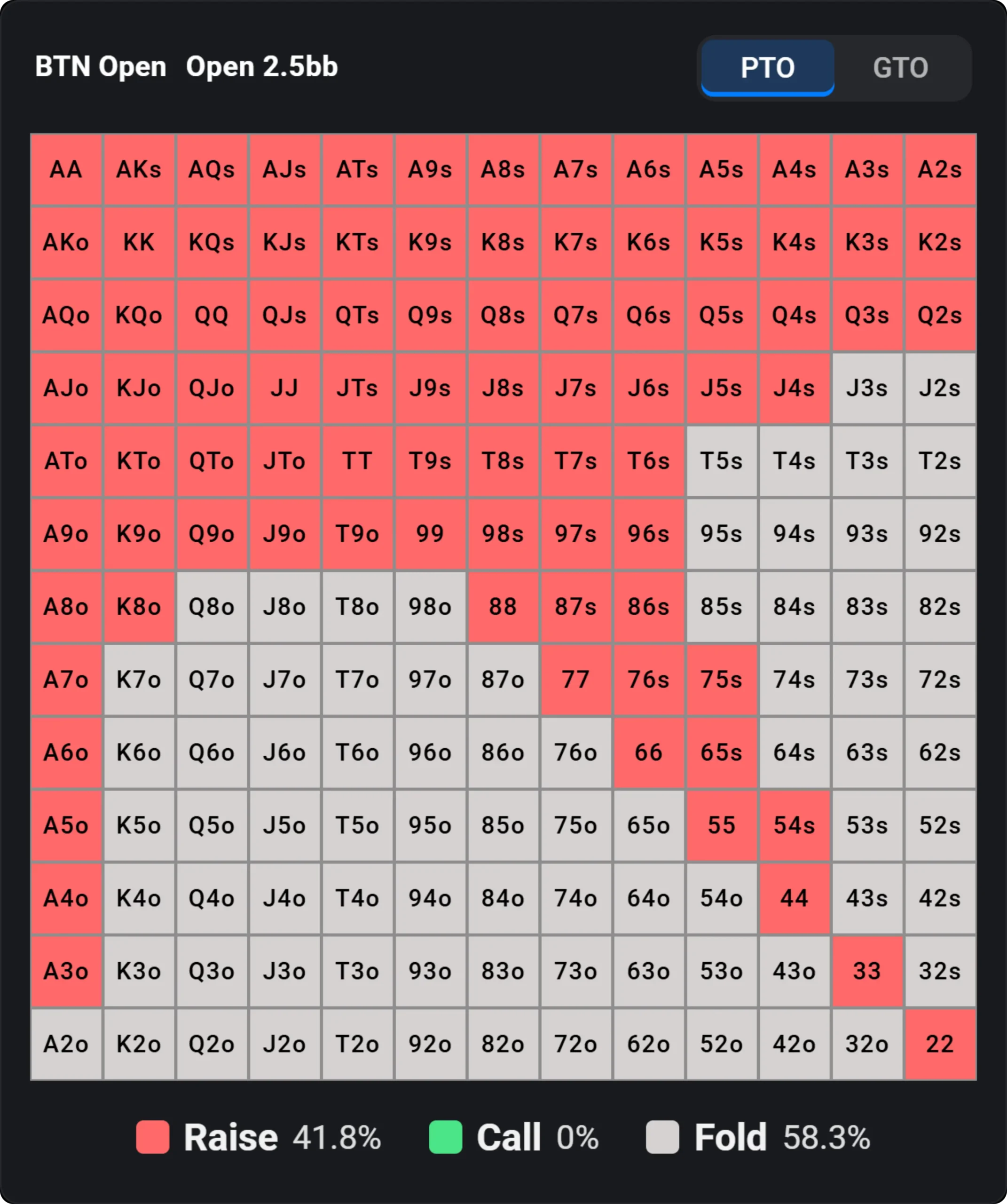
The button is the most profitable position in poker. You only have the two blinds left to act and you will always play the rest of the hand in position.
Because of this advantage you can open a much wider range. Many suited hands and some weaker offsuit hands become profitable opens.
These charts assume the blinds defend reasonably well. If the blinds fold too much, you can expand your button range even further.
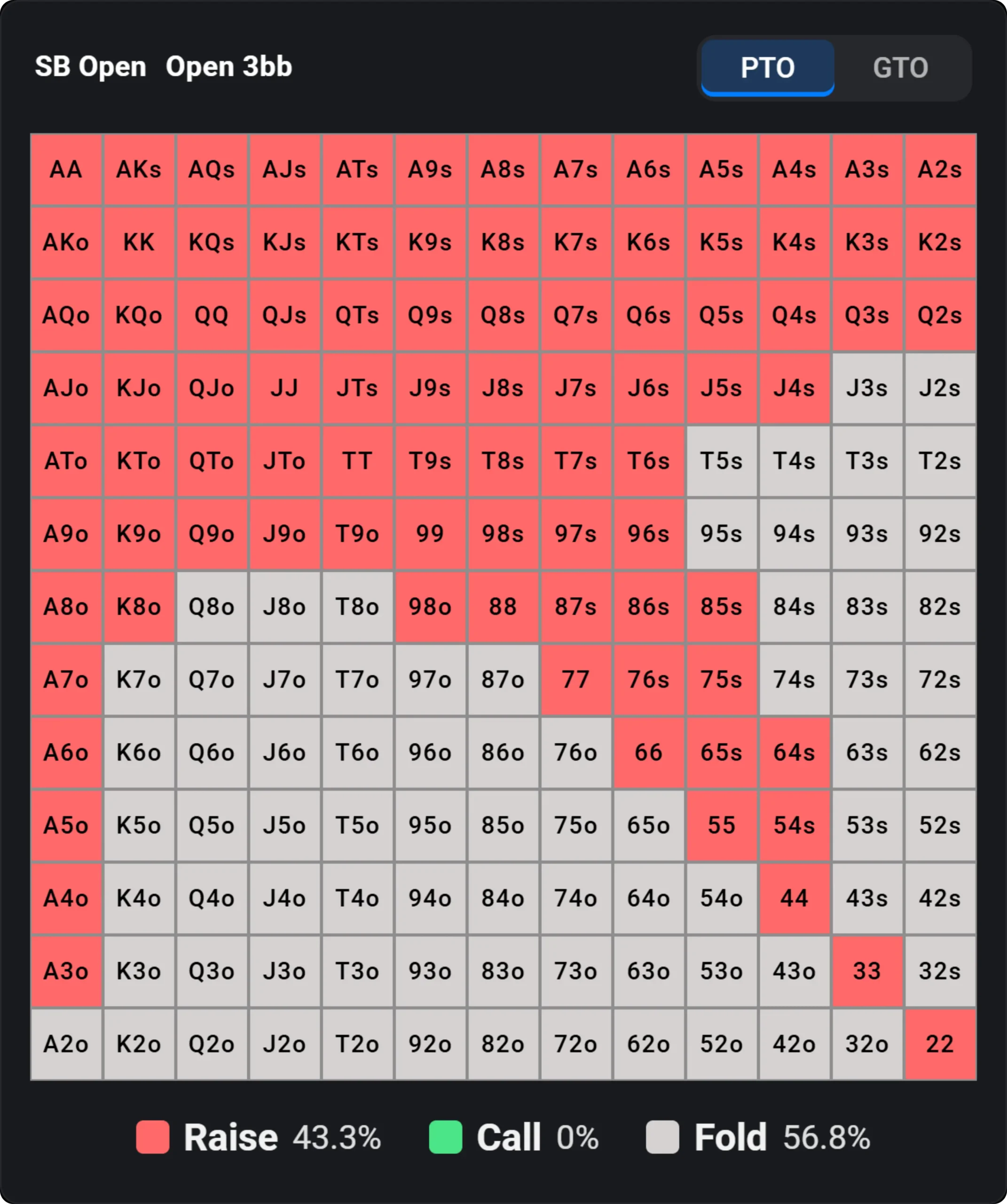
From the small blind you only face the big blind, which allows you to open a very wide range. With just one player left to act, many hands become profitable opens. However, you will always be out of position after the flop, which slightly limits how wide you can go.
In these charts the small blind opens to 3 bb. Overall, the small blind opening range ends up very similar to the button range, but slightly wider because there is only one player left to act.
A poker starting hands chart is a baseline. In real games you can adjust based on your reads on your opponents.
If the blinds fold too much, especially versus button opens, you can open wider. This is one of the most common profitable adjustments in low and mid stakes games.
If the blinds defend a lot and 3-bet often, tighten your weakest opens. Focus more on hands that play well, like suited hands, strong broadways and pocket pairs.
From the small blind, widen your opens against a big blind who folds too much. Tighten if the big blind defends wide and puts you in many tough spots postflop.
Adjustments should be small and logical. Do not abandon structure completely.
When someone limps before you, the pot is no longer unopened. As a starting point, raise to 3 big blinds plus 1 big blind per limper. If two players limp, raise to 5 big blinds.
When you are in position, a simple default is to raise with a range similar to one position earlier. For example, on the button you can raise roughly the cutoff opening range.
Out of position, use a tighter approach.
Many limpers are either fit-or-fold players or calling stations postflop. Against fit-or-fold players, continuation bets often work well. Against calling stations, focus more on value.
The most common opening mistake is playing too many hands from early position. When several players are still to act, strong hands appear more often behind you, so loose opens get punished more often.
Another common leak is being too tight in late position. The cutoff and button are the most profitable seats, and many players give up too much by folding hands that are clear opens there. Modern cash-game strategy also adjusts opening decisions to who is left behind, especially the blinds.
Fixing these mistakes strengthens your whole game, because every hand starts with an opening decision.
Do not try to memorize every square in the chart. Strong players usually learn patterns, borders and a few key anchor hands instead.
Start with the earliest position and move step by step: LJ → HJ → CO → BTN → SB. Learn the tightest range first, then add one position at a time. This makes it easier to see how ranges widen as you get closer to the button.
Use hand categories to simplify the chart. Think in groups such as pocket pairs, suited aces, offsuit aces, broadways and suited connectors. Then identify the weakest hand you still open in each group. That helps you focus on the border of the range instead of trying to remember everything at once.
Most hands are easy. They are either clear opens or clear folds. The hands near the edge of the range are the ones that matter most, because that is where mistakes happen most often.
For example, in the HJ opening range, it helps to think of it as roughly the strongest 21% of hands. Hands like A9o, QTo, 66, J9s, Q8s, K5s, and A2s define the border. These are the kinds of hands worth remembering first.
In Poker Trainer, you can explore exact scenarios in the Range Viewer. Then practice the same spots in Preflop mode inside the Poker Simulator. Repetition with feedback is the fastest way to turn opening ranges into automatic decisions.
A solid poker starting hands chart creates structure and removes guesswork. It is the foundation of strong preflop play.
Master opening poker hands first. Once those feel natural, the next step is learning how to respond when someone enters the pot before you. That means understanding preflop calling ranges and preflop 3-betting ranges.
Strong preflop discipline leads to simpler postflop decisions and more consistent results.
Poker is easy to learn, but hard to master. That is part of what makes it fun. If you want to know how to become better at poker, the key is…
Range construction in poker is about how you organize and play groups of hands, not just the two cards you are holding. Strong players…