

How to get better at poker
Poker is easy to learn, but hard to master. That is part of what makes it fun. If you want to know how to become better at poker, the key is…
Poker
all-in
Going all-in is the biggest moment in poker. One decision and the hand becomes high pressure right away. Either someone folds or the chips go in and the cards decide.
That adrenaline is part of what makes poker fun. It is also why beginners often make their most expensive mistakes in all-in pots. The goal is not to avoid all-ins. The goal is to choose good all-ins and to make disciplined folds and calls when you face one.
This guide covers both going all-in and facing an all-in, preflop and postflop. It also explains the basic rules you need, including side pots.

An all-in is when you bet all your remaining chips. You cannot bet more on later streets, but you are still in the hand and can win whatever you are eligible for.
When you go all-in, two things matter most. How often your opponent folds and how well your hand performs when you get called. The first is fold equity. The second is equity when called.
A good all-in usually works in at least one of these ways. You get called by worse hands. You make better hands fold. Or you have strong equity when called, such as a strong draw.
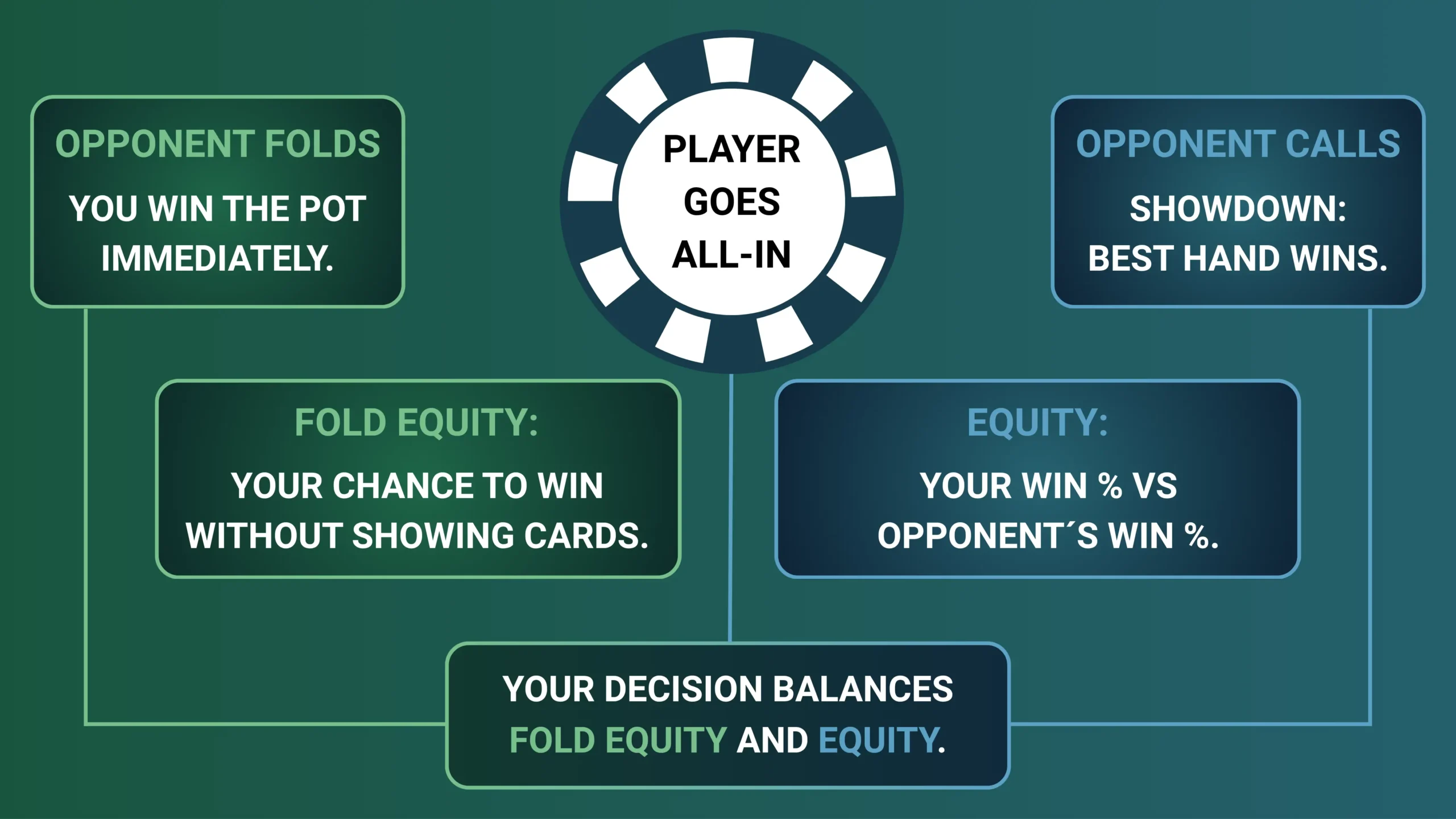
You do not need advanced math to play all-ins well, but it helps to understand one simple idea. An all-in can win in two ways. Your opponent folds and you win the pot right away or your opponent calls and you win at showdown some percentage of the time.
Example:
The pot is 100 and you shove 100.
Villain folds 30% of the time.
If he calls (70%), you win 40% of the time for a net win of 200, and you lose 60% of the time for a net loss of 100.
EV = 0.30×100 + 0.70×(0.40×200 − 0.60×100) = +44.
EV means expected value. It is your average profit or loss if you played the same spot many times. If the opponent folded less or if your equity when called was lower, the EV would drop. That is why good all-ins usually need either solid fold equity, solid equity when called or both.
When you face an all-in, you should think the same way. You are not only looking at your own hand. You are asking what range your opponent is all-in with, and how your hand does against that range.
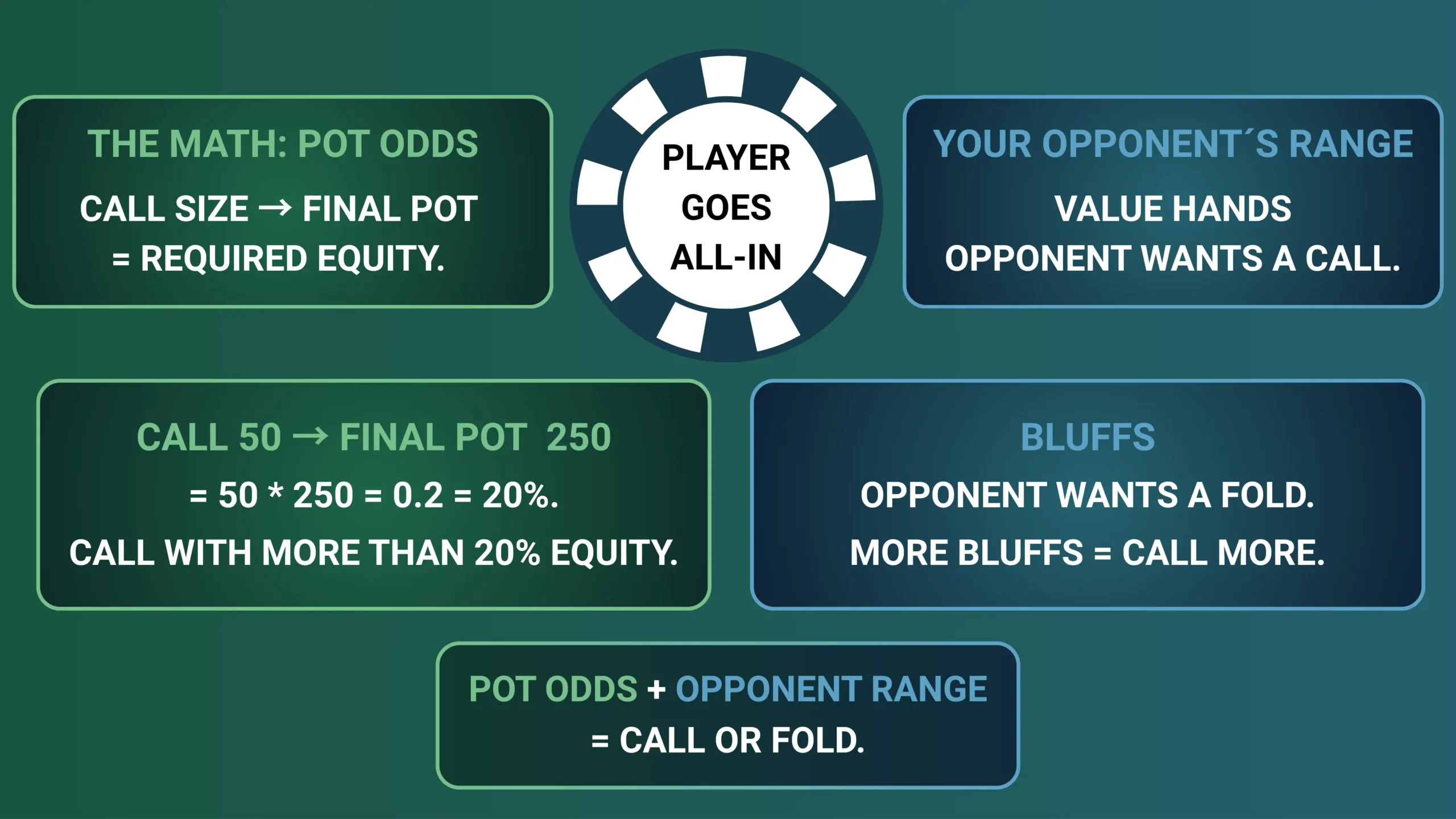
When you face an all-in, pot odds tell you how much equity you need to call. A simple shortcut is: required equity equals the call size divided by the final pot.
Example:
The pot is 150 and your opponent shoves 50.
If you call 50, you can win a final pot of 250. Your break-even equity is 50 divided by 250, which is 20%.
If your hand has more than 20% equity against your opponent’s all-in range, calling is profitable. If it has less, folding is better.
The key is that this depends on ranges, not one hand. If your opponent has many bluffs, your equity goes up. If your opponent is value heavy and almost never bluffing, your equity goes down, and many calls that “feel close” become clear folds.
All-ins create side pots when players have different stack sizes.
If you have the smallest stack and go all-in, you can only win chips up to the amount you put in from each opponent. That part is the main pot.
If other players still have chips behind, they can keep betting into a side pot. Only players who have chips behind can win that side pot. A player who is already all-in cannot win chips he did not match.
Example:
Player A has 20 big blinds.
Player B has 60 big blinds.
Player C has 60 big blinds.
Player A goes all-in for 20 big blinds and gets called.
The main pot is built from 20 big blinds from each player.
If B and C keep betting after that, those bets go into a side pot that only B and C can win.
At showdown, the main pot is decided first. Then each side pot is decided between the players who were eligible for it. This is why you can see a player win a side pot even if another player wins the main pot.
Preflop all-ins happen most often when stacks are short, especially in tournaments. With short stacks there is less room to outplay someone after the flop, so raw equity becomes more important than playability.
This is why hands like pocket pairs and Ace-x hands gain value when stacks get shorter. They win often at showdown and they do not need perfect flops to be strong.
With deeper stacks, playability matters more. Suited hands and connected hands gain value because they can flop strong draws and win big pots when they hit. They also let you control pot size when you miss.
As a rough guideline, many strategies become much more all-in heavy around 20 big blinds and below. Around 15 big blinds and below, open shoves become common in late position and from the small blind.
When you face a preflop all-in, beginners often swing between calling too wide and folding too much. The best habit is to think in ranges and position.
Early position shoves are usually stronger. Late position shoves are usually wider. The same goes for blinds versus late opens. Those spots contain many more bluffs and thin value hands.
Also consider the format. In tournaments, before the money and without strong ICM pressure, players tend to shove wider than in cash games. ICM (independent chip model), means that tournament chips are worth more when you are close to pay jumps, so players often avoid risking their stack without a strong reason. Antes also matter because they increase the reward of winning the pot without a showdown.
If you are unsure, a simple rule is to call tighter versus tight players and early positions and call looser versus aggressive players and late positions. Most big losses come from calling in spots where your opponent is almost never bluffing.
Postflop all-ins happen for three main reasons. You have a strong hand and want to get paid. You have a strong draw and want fold equity plus equity when called. Or the pot is already big and stacks are short relative to the pot, so an all-in is the natural bet size.
This is where excitement can trick you. The pot looks huge and the hand feels important, but the decision should still make sense based on ranges and board texture.
A hand can be strong preflop and still be fragile after the flop. AA is the classic example. Aces are the best starting hand, but after the flop they are often just one pair. On many boards, one pair is not strong enough to play for stacks, especially in multiway pots.
Before you go all-in postflop, ask what worse hands call you. Before you call an all-in, ask what bluffs your opponent realistically has. If those answers do not exist in a believable way, the all-in is usually not good.
Calling an all-in is often harder than shoving, because your opponent controls the pressure. This is where many players make hero calls that feel brave but lose money. Start by listing value hands. What strong hands does your opponent take this line with? Then list bluffs. What missed draws or weak hands would actually shove here?
Board texture matters a lot. On a wet board with many draws, bluffs are more common. On a dry board or after very strong action on earlier streets, bluffs are usually less common.
Pot odds also matter. The bigger the pot is compared to the call, the more bluffs you need to justify a call. But do not hide behind pot odds. If your opponent has almost no bluffs, even a cheap call can be bad.
All-in decisions become easier when you see them often.
In Poker Trainer, you can practice preflop all-in spots in the Poker Simulator. Use Preflop mode and preflop filters to focus on shove and call situations. You can also practice postflop all-ins in Full Hand mode or Postflop mode.
Poker all-ins are exciting because they are high pressure, high impact moments. The key is to make them logical.
Preflop, all-ins become common as stacks get short and raw equity matters more than playability.
Postflop, the biggest mistake is getting stuck with one pair hands when you only get called by better hands or calling when your opponent has almost no bluffs.
Start with solid ranges, think in ranges and you will make much better all-in decisions, even when the adrenaline hits.
Poker is easy to learn, but hard to master. That is part of what makes it fun. If you want to know how to become better at poker, the key is…

Minimum defense frequency (MDF) is a concept from poker math. It describes how often you need to continue against a bet to stop your…