
Opening poker hands
Choosing the right opening poker hands is one of the fastest ways to improve your results. It helps you avoid the most…
Minimum
defense frequency
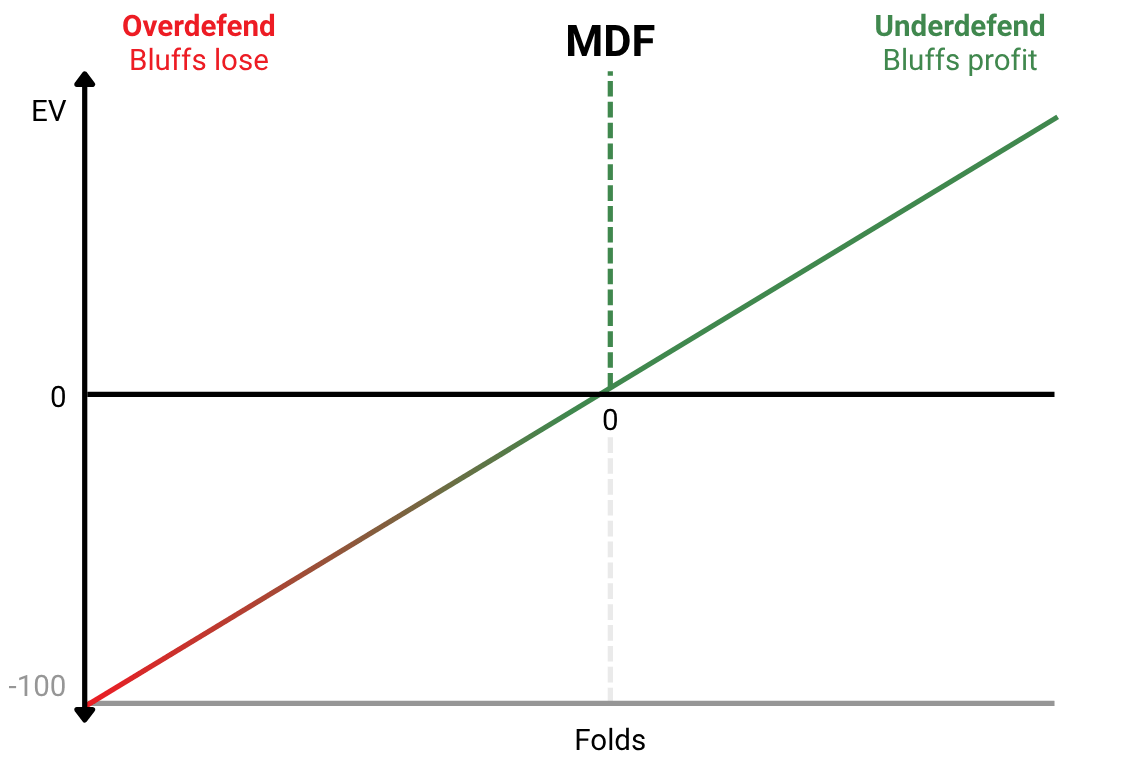
Minimum defense frequency (MDF) is a concept from poker math. It describes how often you need to continue against a bet to stop your opponent from bluffing profitably with any two cards.
In simple terms, MDF makes sure your opponent cannot bet any two cards and automatically make money. If you defend often enough, their bluffs break even instead of making a profit.

Minimum defense frequency is based on risk and reward. When your opponent bets, they risk money to win the pot. MDF tells you how often you must continue so their bluffs have zero expected value in the long run. Defending means you continue in the hand. This can be done by calling or raising, both count as defense. Folding does not.
Before going further, one warning is important. Minimum defense frequency should not be used blindly. If your opponent is not bluffing enough and is betting mostly with strong hands, defending according to MDF will lose money.
It is also important to understand that MDF is a theory tool. Its purpose is to explain how optimal betting and defending ranges are built under certain conditions. It gives structure to poker strategy, but it is not a rule you try to follow at the table.
When deciding whether to bluff on the river, you think about your hand’s showdown value and whether bluffing is more profitable. You also think about your opponent. Will they fold too much, call too much or defend in a balanced way?
When deciding whether to call a river bet, you think about your opponent’s range and how your hand performs against that range. You then compare that to the pot odds you are getting. These ideas are the foundation of strong river decisions.
To understand MDF, it helps to start with the bettor. Imagine a river spot. The pot is 100. A player bets 50 into the pot. They risk 50 to win 100. If the opponent folds, the bettor wins the pot immediately. If the opponent calls, there are no more cards to come and the hand goes to showdown.
In this case, the bettor is risking 50 to win 100. For a bluff to break even, it must work one third of the time. If the opponent folds more than that, the bluff is profitable. If the opponent folds less than that, the bluff loses money.
This number is called the required fold frequency (sometimes fold equity). You can calculate it with a simple poker math formula:
Required folds = risk / (risk + reward) a bluff to break even.
For a pot-sized bet, the pot is 100 and the bettor bets 100.
The risk is 100 and the reward is 100.
Required folds = 100 / (100 + 100) = 50%.
So the opponent must fold at least 50% of the time for a bluff to break even.
From the defender’s side, the logic flips. If a bluff needs the opponent to fold 50% of the time to break even, then the opponent must continue 50% of the time to prevent automatic profit. That number is the minimum defense frequency.
Required folds and MDF always add up to 100%.
If a bet needs 33% folds, MDF is 67%.
If a bet needs 50% folds, MDF is 50%.
If a bet needs 60% folds, MDF is 40%.
Before the river, this becomes much more complicated. On earlier streets, bluffs can improve, calls can win on later streets and future betting changes the expected value of every decision. That is why MDF is most useful on the river, where no future cards remain.
Bet size controls pressure. Small bets risk little money and need only a few folds to break even. Large bets risk a lot of money and need many folds to break even.
Because of this, larger bets allow more bluffs, not fewer. A big bet forces more folds. If the opponent folds too much, the bettor can include many bluffs and still profit. This is why large bets are often used with polarized ranges. A polarized range contains strong value hands and bluffs, but very few medium-strength hands.
| Bet size | Required folds | MDF | Pot odds | Value / bluff |
|---|---|---|---|---|
|
25% |
20% |
80% |
17% |
83% / 17% |
|
33% |
25% |
75% |
20% |
80% / 20% |
|
50% |
33% |
67% |
25% |
75% / 25% |
|
75% |
43% |
57% |
30% |
70% / 30% |
|
100% |
50% |
50% |
33% |
67% / 33% |
|
150% |
60% |
40% |
38% |
62% / 38% |
As bet size increases, required folds go up. MDF goes down. The betting range can contain a higher percentage of bluffs.
A simple way to remember value and bluff frequencies is this: your bluffing frequency should match the odds you are offering your opponent to call. When you bet, you are giving your opponent a price to continue.
In a balanced situation, this makes your opponent’s marginal hands, often called bluffcatchers, indifferent between calling and folding. Bluffcatchers are hands that usually beat bluffs but lose to strong value hands.
If you offer good odds with a small bet, your range must contain fewer bluffs. If you offer poor odds with a large bet, your range can contain more bluffs. This is where the value and bluff ratios in the table come from.
Minimum defense frequency assumes your opponent is bluffing at something close to the correct frequency.
It also assumes the betting range is balanced between value hands and bluffs, and that the range is polarized. These conditions are most common on the river. In that situation, their bluffs break even in the long run.
MDF also exists in multiway pots, but the duty to defend is shared between multiple players. No single player must meet MDF alone. The logic still applies, but the math and practical use become more complex.
The real value of MDF is not memorizing numbers and trying to use them at the table. MDF is mainly a study tool. It helps you understand how pressure works, how bet sizing affects defense and why some ranges contain many bluffs.
By understanding minimum defense frequency, you get a clearer picture of poker math. This makes it easier to reason about bluffing, defending and bet sizing, even if you never think about exact frequencies during a hand.
Choosing the right opening poker hands is one of the fastest ways to improve your results. It helps you avoid the most…

Poker players often ask whether they should play GTO poker or focus on exploitative play. This question comes up a lot and much of the…