

GTO poker vs exploitative play
Poker players often ask whether they should play GTO poker or focus on exploitative play. This question comes up a lot and much of the…
Bluffing
in poker
In poker, you can win a hand in two ways. You can win by having the best hand at showdown. Or you can win by making your opponent fold. Bluffing starts with understanding the second way to win.
Winning at showdown often happens by checking or calling and then showing your cards. Making your opponent fold requires aggression. It only happens when you bet or raise. Strong players use both ways to win, depending on the situation.
When you have a strong hand, betting or raising is natural. You want to build the pot and get value. If you always check or only call with your best hands, you often lose value. But poker is not only about strong hands. Many times your hand is unlikely to win if the cards are shown. In those spots, betting can be your only realistic way to win.
A bluff is when you bet or raise with a hand you do not expect to win at showdown. You are not relying on your cards. You are relying on the chance that your opponent will fold. This is why people talk about fold equity. When you bet, you can win even if your opponent would have had a better hand at showdown.
Bluffing also needs to work together with value betting. If you only bet strong hands, opponents can fold too easily. If you bluff too often, opponents will start calling more. To understand how often to bluff compared to value bet, and how often your opponent must fold for a bluff to be profitable, see our guide on minimum defense frequency (MDF).
Bluffing is not equally good against everyone. Some players call too much, even with weak hands. Against them, you still bluff, but you choose your bluffs more carefully. You focus more on value betting, because they pay you off.
Many of these players call too wide on the flop and turn. But on the river, when draws miss and they hold a weak hand, some of them start folding more. That is why river bluffs can still work well against certain players, even if earlier street bluffs do not.
Other players fold more when they feel pressure, especially on later streets. Against them, you can bluff more often and use bigger bets. They protect their stack and do not like calling with medium hands.
In most poker games you need to bluff quite a lot. If you almost never bluff, good opponents can fold too easily when you bet. You then win small pots and lose the big ones. Bluffing is part of a healthy strategy, not a rare trick.
Multiway pots change bluffing a lot. When there are three or more players, bluffing becomes harder because you need more than one opponent to fold. Someone is also more likely to have a strong hand or a draw they can continue with.
This means you should bluff less often in multiway pots, especially with pure bluffs. When you do bluff, it is usually better to use hands with good equity, like strong draws and to pick boards that miss most players.
So the goal is not to avoid bluffing. The goal is to bluff often enough, but in the right spots, with the right hands and against the right opponents.
In real poker, you almost never know your opponent’s exact hand. You think in ranges. A range is the set of hands your opponent could have based on the action so far. Good bluffs target spots where many of those hands are weak or uncomfortable facing a bet.
Many bets are polarized, meaning you bet very strong hands and bluffs, while medium hands often check. If you have a nut advantage (more of the strongest hands as part of your range) and your opponent’s range is capped you can bet big and have more bluffs in your range. Learn more in our guide to range construction.
If your opponent’s range contains many marginal hands, pressure works well. If your opponent’s range is very strong, bluffing is often a mistake. Your story is less believable, and your opponent is more likely to call or raise.
Before the river, bluffing often looks different because you can still improve. A semi-bluff is when you bet with a hand that is currently weak but can become strong later. Straight draws and flush draws are common semi-bluffs. You can win in two ways, by making your opponent fold or by improving to the best hand.
A pure bluff is when you bet with a hand that has no real chance to improve. This often happens on the river after you miss a draw.
Here is a simple example. You reach the river with jack-high after missing a straight draw. If you check, you will almost always lose at showdown. If you bet, you give yourself another way to win. Your opponent may have a weak pair or a missed draw and decide to fold. If your opponent folds often enough, the bluff can be profitable even though your hand is bad.
What do you do?
On the river, you have 7-high. If you check, you will almost never win a showdown. Villain can easily have a king, an eight, a pocket pair, or even jack-high that now beats you. So checking is a low EV option.
If you run this spot in a solver, the result can be surprising. In this line, a pot-sized bet is used 100% of the time with this hand. Villain folds about 53% of the time and the EV of betting is around +0.5 bb. The reason is simple. Your turn overbet represents a very strong range and Villain reaches the river with many hands that are not strong enough to call a big bet.
When you hold diamonds, you block some of the hands Villain can have that would fold on the river, especially missed diamond draws.
In other words, you remove part of Villain’s folding region. That makes your bluff less likely to succeed.
This is called having blockers to the folding region. Most of the time, blockers do not change a decision by much. But in some river spots when ranges are narrow, they can matter quite a bit. Flush draw blockers and flush blockers are common examples.
One more point is that human opponents do not play like solvers. Even small changes in folding frequency can matter a lot. If Villain overfolds on the river, a bluff becomes better.
In practice, opponent tendencies usually matter more than blockers, unless you play very high stakes. Humans are never perfectly balanced.
Learning how to bluff is not about bluffing more often. It is about choosing better spots. Good bluffs make sense based on the board, the action, your opponent, and the range of hands your opponent can have. The better you are at hand reading, the better your bluffs will work.
Poker without bluffing becomes limited. You may still win against weak opponents who call too often, but your progress will often stop when opponents improve.
Bluffing is not about tricking people for its own sake. It is a logical part of poker built on pressure, ranges, and decision-making. Like all poker skills, it improves with study and practice over time.
If you want to train this in a structured way, the Poker Simulator helps you practice decisions street by street. You learn how bluffing fits together with value betting, board texture and the overall actions in the hand instead of guessing.
Poker players often ask whether they should play GTO poker or focus on exploitative play. This question comes up a lot and much of the…
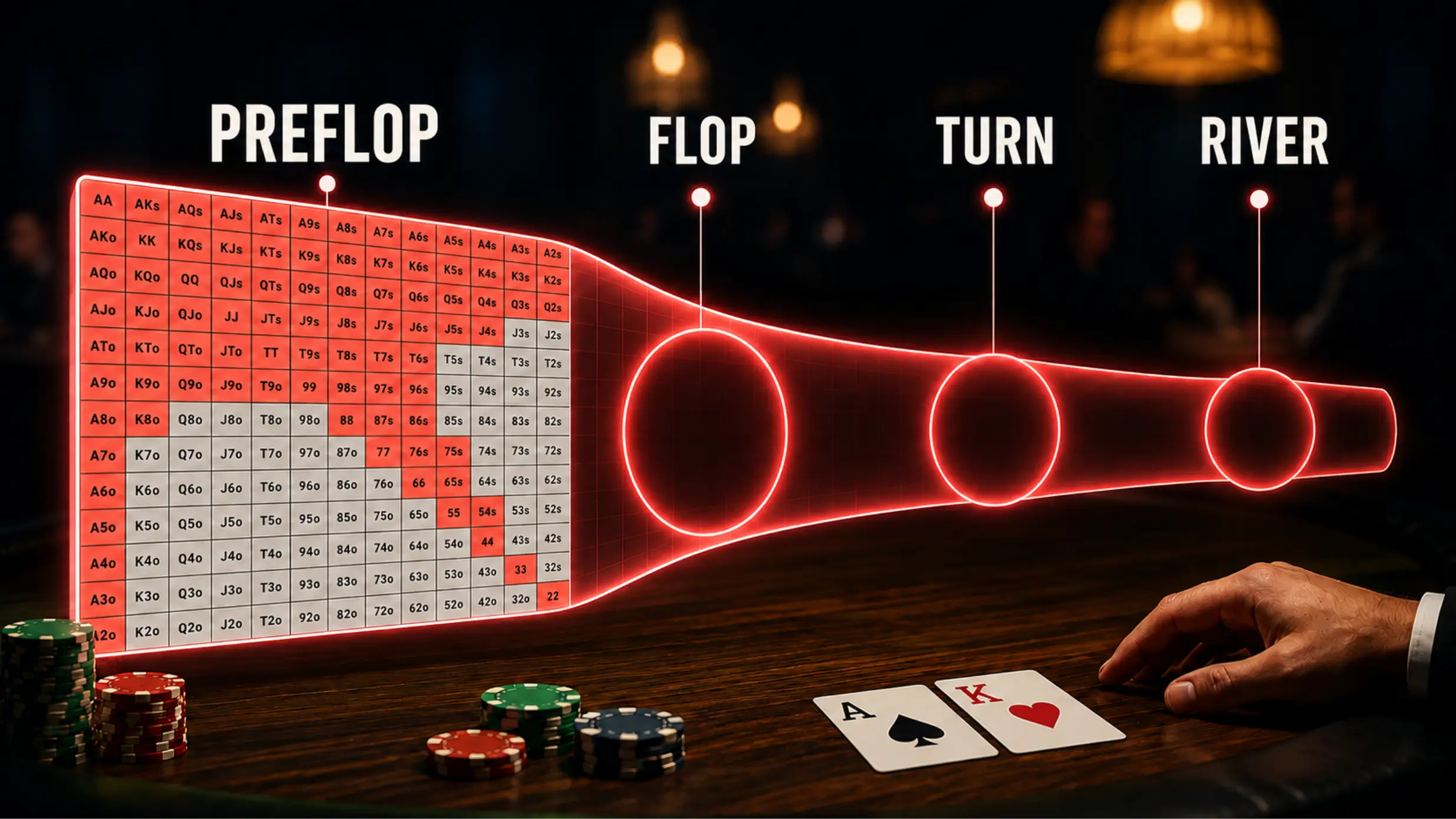
Poker hand reading means working out what hands your opponent can still have as the action unfolds. Good players…