
Poker bankroll management
Bankroll management is one of the most important skills for aspiring poker players. It helps you avoid going broke, reduces stress and makes…

The three reasons
to bet
Many players see a decent hand and they bet. They see a weak hand and they check. This often leads to decisions that are hard to explain later.
Some players also do the opposite and slowplay too much, checking or calling strong hands without a clear reason and missing value.

In poker, every bet and raise should have a purpose. There are three main reasons. Value, bluff and protection. These buckets describe the primary purpose.
A value bet can also deny equity. A bluff can also win when it improves. What matters is what you most want to happen.
This framework applies to betting and raising, not only betting.
When you bet for value, you want your opponent to call. A helpful way to think about value is your equity against the calling range. In a heads-up pot, a value bet means you expect to have more than 50% equity against the hands that call.
When this is the case, putting more money into the pot is good for you. If you win more than half the time when called, every additional chip that goes into the pot increases your expected profit.
That is why strong hands want to build the pot, while weaker hands prefer smaller pots or no action at all.
If you expect to be behind most of the time when called, the bet is no longer a clear value bet.
Thin value means your hand is only slightly ahead of the calling range. You are happy to get called, but it is close. These bets are often small, because a small bet keeps the opponent’s calling range wider.
To avoid being obvious, you should normally include some strong hands in the same small bet size.
Thick value means your hand is far ahead of the calling range. Many worse hands can call, and you feel comfortable building a pot.
Multiway pots change the numbers. You do not need more than 50% anymore, because you are not trying to beat one player. You always want more than your fair share of the pot when value betting.
Your fair share is 1 divided by the number of players.
Multiway value bets are usually thick value and thin value is rare.
When you bluff, you want your opponents to fold. This is the core idea behind bluffing in poker. You expect to lose too often when called, so you need fold equity to make the bet profitable or break-even.
Fold equity simply means the chance that your opponent will fold to your bet. The more often your opponent folds, the more profitable your bluff becomes.
Even if your hand is weak, winning the pot immediately when your opponent folds can make the bet a good play in the long run.
Pure bluffs and semi-bluffs are both bluffs, but they feel very different.
A pure bluff has very low equity when called. It is close to dead if it gets called. In theory, pure bluffs are close to 0 EV in balanced GTO play most of the time. They are used to support the value range, not because they print money by themselves.
A semi-bluff is a bluff with real equity. It is usually a draw, like a flush draw or straight draw. You still prefer folds, but you also win a meaningful amount of time when called. Semi-bluffs can also create big pots for the times you improve and get paid.
To understand when bluffing makes sense, see our guide on bluffing in poker.
The image below is a simple guide. It is not a strict rule. It is a typical way to think about average equity when called against one opponent.
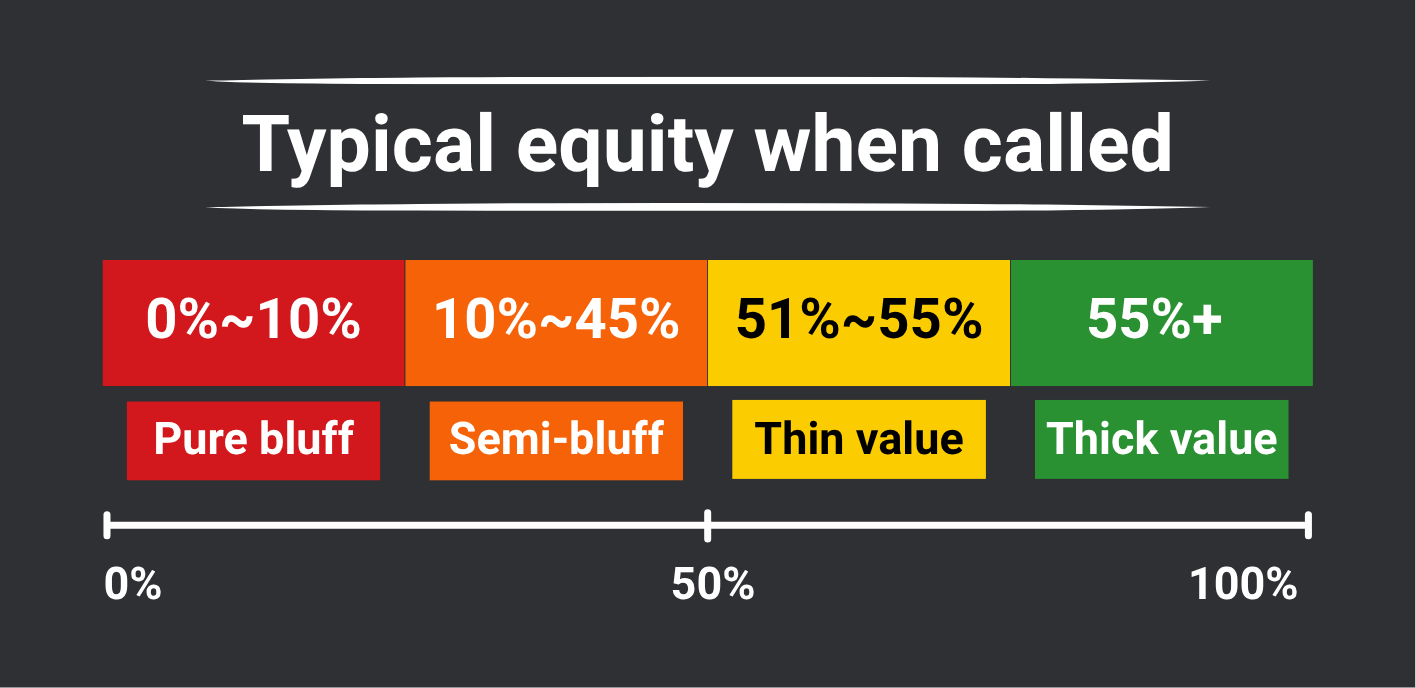
Your equity when called is not a fixed number. It depends on which hands your opponent calls with and your bet size heavily influences that.
A small bet usually gets called by a wider range. That often increases your equity when called with medium-strength hands, which is why thin value is commonly paired with small sizing.
A large bet usually gets called by a tighter range. That can lower your equity when called unless your hand is very strong.
Bet size also affects fold equity. Large bets usually create more folds than small bets. This matters a lot for bluffs and it also matters for value bets when you want calls from worse hands.
Bet size also affects the raising range. Some opponents raise much more versus small bets. Other opponents raise mostly versus large bets. This changes which hands continue and which hands leave the pot.
Your equity when called is not a fixed number. It depends on which hands your opponent calls with and your bet size heavily influences that.
Even if you have slightly more than 50% equity against the calling range, the bet might still not be profitable.
One reason is the risk of getting raised by a polarized range. A polarized raise range contains strong value hands and bluffs. Some of the value raises are hands you were going to lose to anyway.
The problem is the bluff raises. They can push you off your equity and turn a thin value bet into a mistake. This is another reason thin value works best with smaller sizing and in spots where getting raised is not very likely.
When you bet for protection, you usually have a medium-strength hand that is likely best right now.
You bet to deny equity. You make weaker hands pay to continue or you make them fold and lose decent equity, instead of letting them see a free card that could beat you.
Protection bets are most common on the flop, where many turn and river cards can change the situation.
A typical example is when you have 88 on the button, you raise and the big blind calls. The board is 7-4-2.
The opponent has many hands with two overcards in their range. You want them to fold their roughly 25% equity immediately.
88 is betting more often than AA in this scenario. The reason is that 88 is vulnerable to high cards hitting the opponent’s range.
Protection bets are usually small bets with medium-strength hands. They are often thin value + equity denial.
You get called by some worse hands and you make many overcards and weak draws fold. Protection bets should be used with caution to avoid isolating ourselves against a stronger range.
Before you bet or raise, ask what you most want to happen. If you most want a call, it is value. If you most want a fold, it is a bluff. If you most want to deny a free card, it is protection.
This keeps your decisions logical and makes your strategy easier to improve. Sometimes the lines are blurred and a bet needs a mix of calls and folds to be profitable.
This keeps your decisions logical and makes your strategy easier to improve. Sometimes the lines are blurred and a bet needs a mix of calls and folds to be profitable.
Bankroll management is one of the most important skills for aspiring poker players. It helps you avoid going broke, reduces stress and makes…
Poker equity is how often you expect to win the pot at showdown if no more betting happens. It represents your share of the pot and answers how…
| Cookie | Duration | Description |
|---|---|---|
| cookielawinfo-checkbox-analytics | 11 months | This cookie is set by GDPR Cookie Consent plugin. The cookie is used to store the user consent for the cookies in the category "Analytics". |
| cookielawinfo-checkbox-functional | 11 months | The cookie is set by GDPR cookie consent to record the user consent for the cookies in the category "Functional". |
| cookielawinfo-checkbox-necessary | 11 months | This cookie is set by GDPR Cookie Consent plugin. The cookies is used to store the user consent for the cookies in the category "Necessary". |
| cookielawinfo-checkbox-others | 11 months | This cookie is set by GDPR Cookie Consent plugin. The cookie is used to store the user consent for the cookies in the category "Other. |
| cookielawinfo-checkbox-performance | 11 months | This cookie is set by GDPR Cookie Consent plugin. The cookie is used to store the user consent for the cookies in the category "Performance". |
| viewed_cookie_policy | 11 months | The cookie is set by the GDPR Cookie Consent plugin and is used to store whether or not user has consented to the use of cookies. It does not store any personal data. |