
Texas Hold’em rules
Poker is a card game played by 2 to 10 players. Texas Hold’em rules describe the most popular poker variant in the world, both online and…
Poker
squeeze
A squeeze is a preflop 3-bet after there has been an open raise and one or more callers. It is called a squeeze because the original raiser is “squeezed” between you and the players who called.
Squeezing works because the caller is often capped. Many players flat-call with hands that are not strong enough to 3-bet and those hands have a hard time continuing against a big re-raise.
At the same time, the opener is often raising a wide range, especially from late position and may fold more than he should when he faces pressure.
Another reason is dead money. There is already a raise and a call in the pot, so you do not need your squeeze to work very often for it to be profitable. When it does work, you win a pot that is already bigger than normal without seeing a flop.
Squeezes become much stronger when you have position. Squeezing on the button or cutoff is easier because you will act last postflop if you get called. That allows you to c-bet more effectively, control pot size and realize equity with your bluffs.
Lineup matters a lot. Squeezing is best when the opener is capable of folding and the caller is loose or passive. A common profitable spot is a late position open followed by a flat-call from a player who likes to see flops.
That caller usually folds too much to a squeeze and the opener often does not want to play a big pot out of position versus you.
Stack depth matters too. At very short stacks, many spots turn into all-in poker and the squeeze loses some of its edge.
At medium and deep stacks you get more fold equity and you also get more reward from having a well built range and good postflop play.
Some situations are simply bad for squeezing. If the opener is tight, his range is stronger and he will defend more often versus 3-bets.
This is especially true versus early position opens in full ring games, where the opening range is naturally tighter. This doesn’t mean you will never squeeze, just that you need a stronger range.
You should also be careful when the caller is strong or tricky. Some good players flat-call with hands that continue a lot versus squeezes and some players slowplay premium hands. When the caller does not fold often, your squeeze loses a big part of its profit.
Finally, think about how the table reacts to 3-bets. If you are in the blinds and both the opener and the caller are aggressive, you can get 4-bet more often. That increases variance and forces you to defend wider than many beginners are comfortable with.
A squeeze range is usually built from two parts. Value hands are the hands you are happy to get called with and can comfortably play for a larger pot. Strong pocket pairs and strong broadways are common examples.
Your bluffs should have a reason to exist. A good bluff often blocks strong continuing hands, and still has playability when called. This is why suited aces and suited broadways are popular squeeze bluffs.
They can make strong top pairs, they can flop strong draws and they remove some of the strongest hands from your opponent’s possible holdings.
A common beginner mistake is squeezing with hands that look strong but play poorly when called, such as weak offsuit broadways. These hands get dominated and struggle in bigger pots, especially out of position.
In general you want to squeeze bigger than a normal 3-bet, because the pot is larger and you are more likely to get called. A simple baseline at 100 big blinds is to go about 4x the open raise when you are in position, and about 5x the open raise when you are out of position. Read more in our guide to preflop bet sizing.
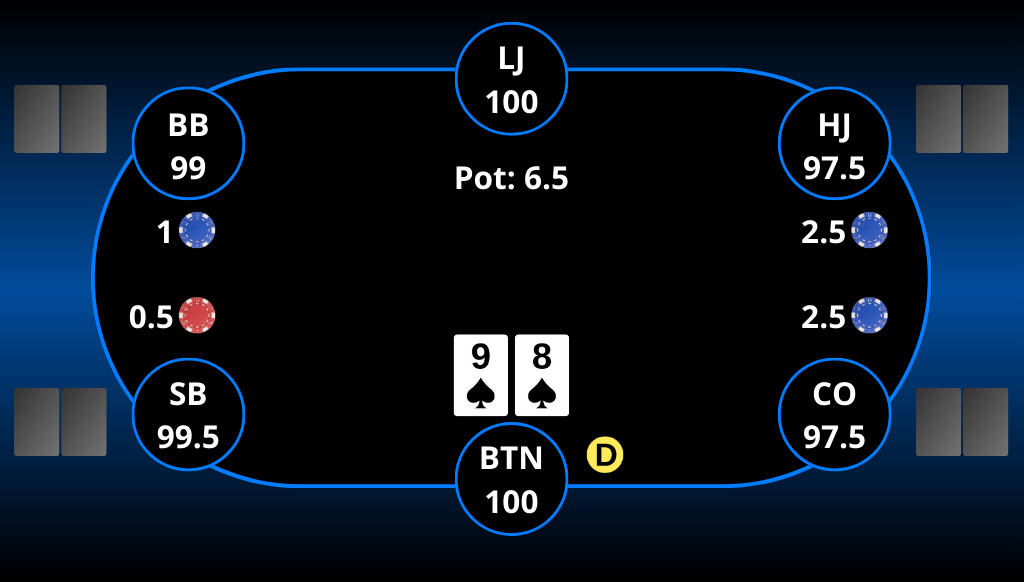
In the earlier example, LJ opens 2.5 bb and HJ calls. On the button, a squeeze to around 10 bb is a solid default. In the big blind, you can often go to around 12.5 bb to 14 bb, since you will be out of position postflop and want to reduce the caller’s ability to realize equity.
Before you squeeze, think about why it should work in this exact spot. Ask how wide the opener is, how likely the caller is to fold and whether you will have position after the flop.
Also consider what happens when you get called. If you do not feel comfortable playing a bigger pot with your hand, it is often better to fold or call instead.
If you want one simple rule, squeeze more when the opener is wide and folds too much and when the caller is loose and folds too much to 3-bets.
Squeeze less when the opener is tight, when the caller is strong and when you are out of position against opponents who defend aggressively.
Squeezing is one of the best ways to win pots without seeing a flop. It works because flat-calling ranges are often weak and because there is already dead money in the pot.
The keys are choosing good lineups, using a solid size and picking hands that can handle getting called. When those pieces are in place, squeezing becomes a profitable and fun weapon to add to your preflop strategy.
Poker is a card game played by 2 to 10 players. Texas Hold’em rules describe the most popular poker variant in the world, both online and…

One of the most important concepts in poker is poker position. Where you sit at the table strongly affects which hands you can play, how…