Range construction in poker
Range construction in poker is about how you organize and play groups of hands, not just the two cards you are holding. Strong players…

Poker
win rate
Most poker players want to know their poker win rate as quickly as possible. This is natural. You want to know if your results are mostly driven by luck or if you are actually winning over time.

The problem is that poker results are noisy. Short-term results are heavily affected by luck. A good run can make a losing player look strong. A bad run can make a winning player look weak.
Because of this, win rates always need context. You must understand variance, sample size and what your results can and cannot tell you.
Variance is the natural up and down in results caused by chance. In poker, cards, runouts, and all-ins create large swings. Even when you make good decisions, short-term outcomes can be negative.
This means your observed poker win rate is only an estimate of your true skill. With a small sample, this estimate can be very inaccurate. With a larger sample, it becomes more reliable.
A common beginner mistake is to treat 10,000 hands as proof. It is not. At that point, luck still plays a very large role.
Getting close to your true long-term poker win rate requires a very large sample. For most cash game players, results start to stabilize in a meaningful way somewhere around 200,000 hands or more.
However, there is an important distinction. You do not need 200,000 hands to decide whether you are likely a winning or losing player.
If you are clearly losing after 50,000 hands at the same stake and format, that is a strong warning sign. It does not mathematically prove you are a losing player, but it is enough to justify changes. You should study more, fix leaks or move down in stakes.
If you are clearly winning over the same sample, that is a good sign. But it still does not lock in your exact win rate. Luck can still have a big influence.
A simple way to think about it is this:
A poker variance calculator is a useful tool for building intuition. It shows how wide results can be, even for winning players.
One popular variance calculator is Primedope. By entering your sample size, expected win rate and standard deviation, you can simulate many possible outcomes. This makes it clear why a strong player can still be losing after a large number of hands.
The higher your win rate is, the faster your results tend to stabilize. A small edge takes a long time to separate itself from luck, while a large edge shows up sooner, even though variance is always present.
Variance calculators are not about prediction. They are about understanding uncertainty. They help you avoid drawing emotional conclusions from short-term results.
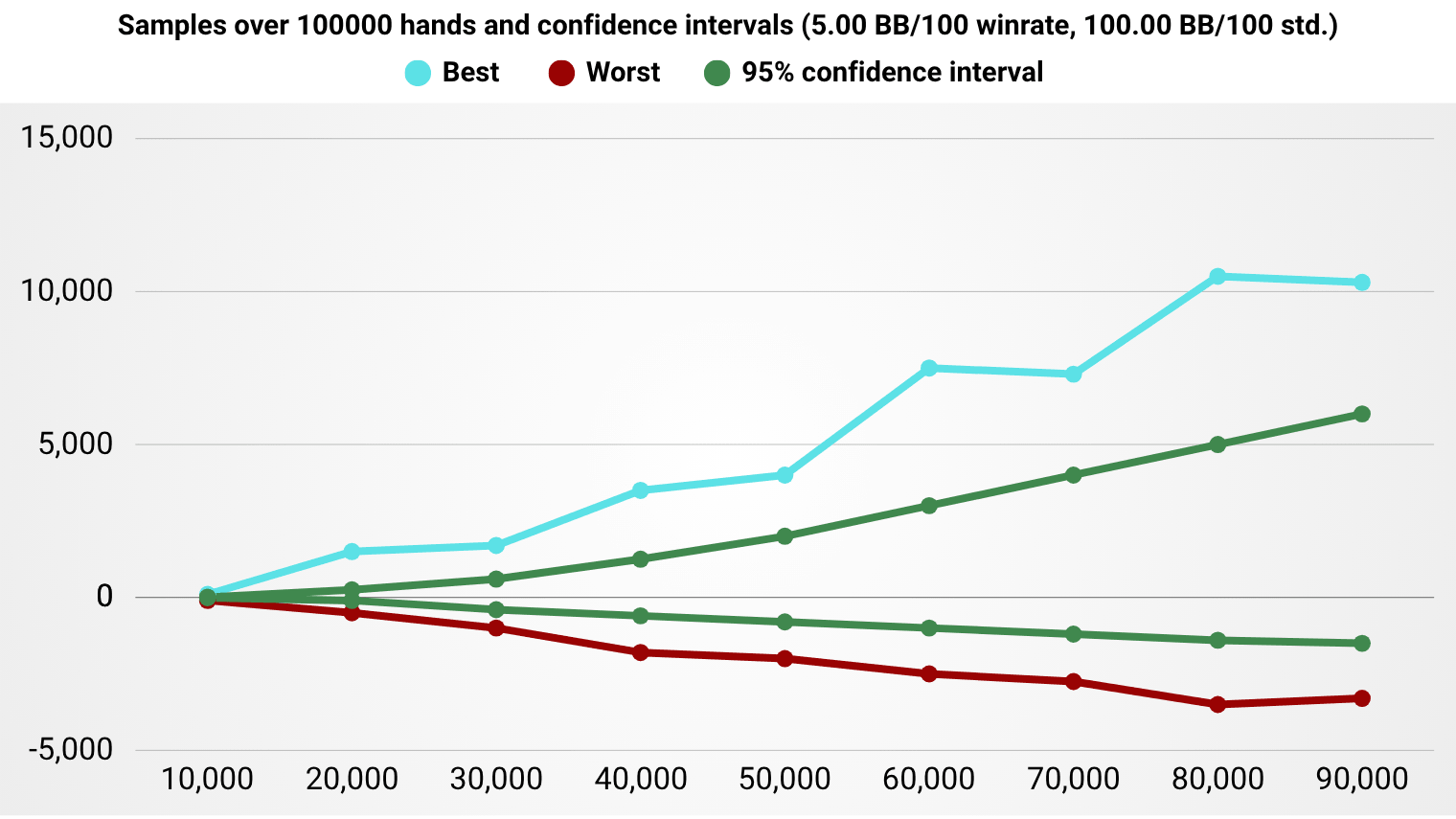
Simplified illustrative example based on Primedope.
Cash games and tournaments behave very differently. In cash games, win rate is usually measured in big blinds per 100 hands. Variance is high, but results tend to stabilize faster than in tournaments. With consistent volume, you can often get a reasonable idea of whether you are winning or losing relatively early.
MTTs are different. Tournament results are usually measured using ROI (Return on Investment). Payouts are top-heavy, meaning a large part of your profit can come from a few deep runs. This creates extreme variance.
In tournaments, a few hundred games tell you very little. Even 1,000 tournaments can still be very noisy, especially in large fields. Determining your true win rate in MTTs often takes far more volume than most players expect.
Live poker adds another layer. Live games are often much softer than online games. Because opponents make larger mistakes, your poker win rate can be much higher in live games.
The downside is volume. Live poker is slow. You may see only 25 to 35 hands per hour. Online, you can often see many times that amount. This means it takes much longer to build a meaningful sample live. Even if your hourly profit looks good, conclusions based on a small number of live sessions can be misleading.
Variance is not just a theory problem. It directly affects your bankroll. Even winning players experience long losing stretches. Without proper bankroll management, a normal downswing can force you to quit or move down in stakes at the worst possible time.
Cash games require a solid bankroll. Tournaments usually require a much deeper one. Large-field MTTs require even more. Bankroll management is what allows your skill to show over time. Without it, variance can end your poker journey before your edge has a chance to matter.
Use results for guidance, not validation. Track your hands. Look for trends, not short-term spikes. Use a poker variance calculator to remind yourself how wide outcomes can be. Focus on decision quality, study habits, and consistency. Results follow later.
If you remember one thing, remember this:
Your goal is not to prove anything quickly, but to improve steadily and survive variance long enough for your true poker win rate to appear.
Range construction in poker is about how you organize and play groups of hands, not just the two cards you are holding. Strong players…

Poker is a game of skill and luck. Even very good players will have periods where they lose more than usual. This is called a downswing…