
GTO poker vs exploitative play
Poker players often ask whether they should play GTO poker or focus on exploitative play. This question comes up a lot and much of the…

Range construction
in poker
Range construction in poker is about how you organize and play groups of hands, not just the two cards you are holding. Strong players always think about their own range and their opponent’s range and how those ranges interact on a given board.
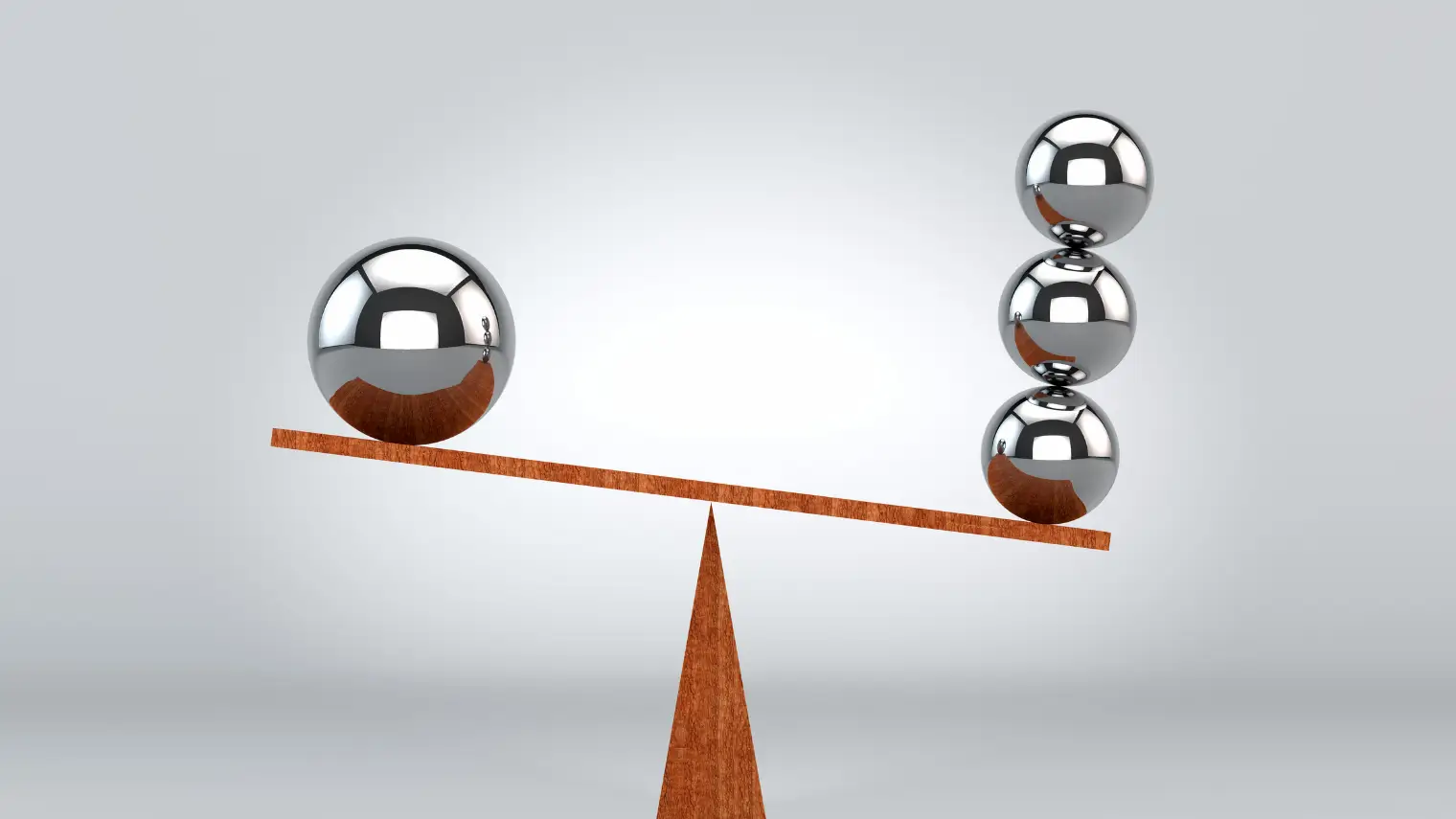
This concept is closely connected to bluffing in poker, bet sizing, and pressure. When range construction is done well, your strategy becomes harder to exploit and your bluffs and value bets support each other naturally.
A poker range is the collection of hands a player can reasonably have in a given situation. Preflop, this depends on position and action. Postflop, ranges narrow quickly as players check, bet, call, raise or fold.
Good range construction means that your actions make sense for the entire group of hands you represent, not just your specific holding.
A linear range is built from the top down. It starts with the strongest hands and continues through medium-strength hands, stopping before the weakest hands. Linear ranges naturally appear when you only have one way to continue in a hand. If you can only raise or fold, or only call or fold, it makes sense to continue with your best hands and fold the rest. In these situations, ranges are linear by definition.
A common example is a preflop opening range. From the button, you open many hands, but they are ordered by strength. Premium hands, strong broadways, medium pairs, suited aces, and suited connectors all appear because they benefit from position and can realize equity.
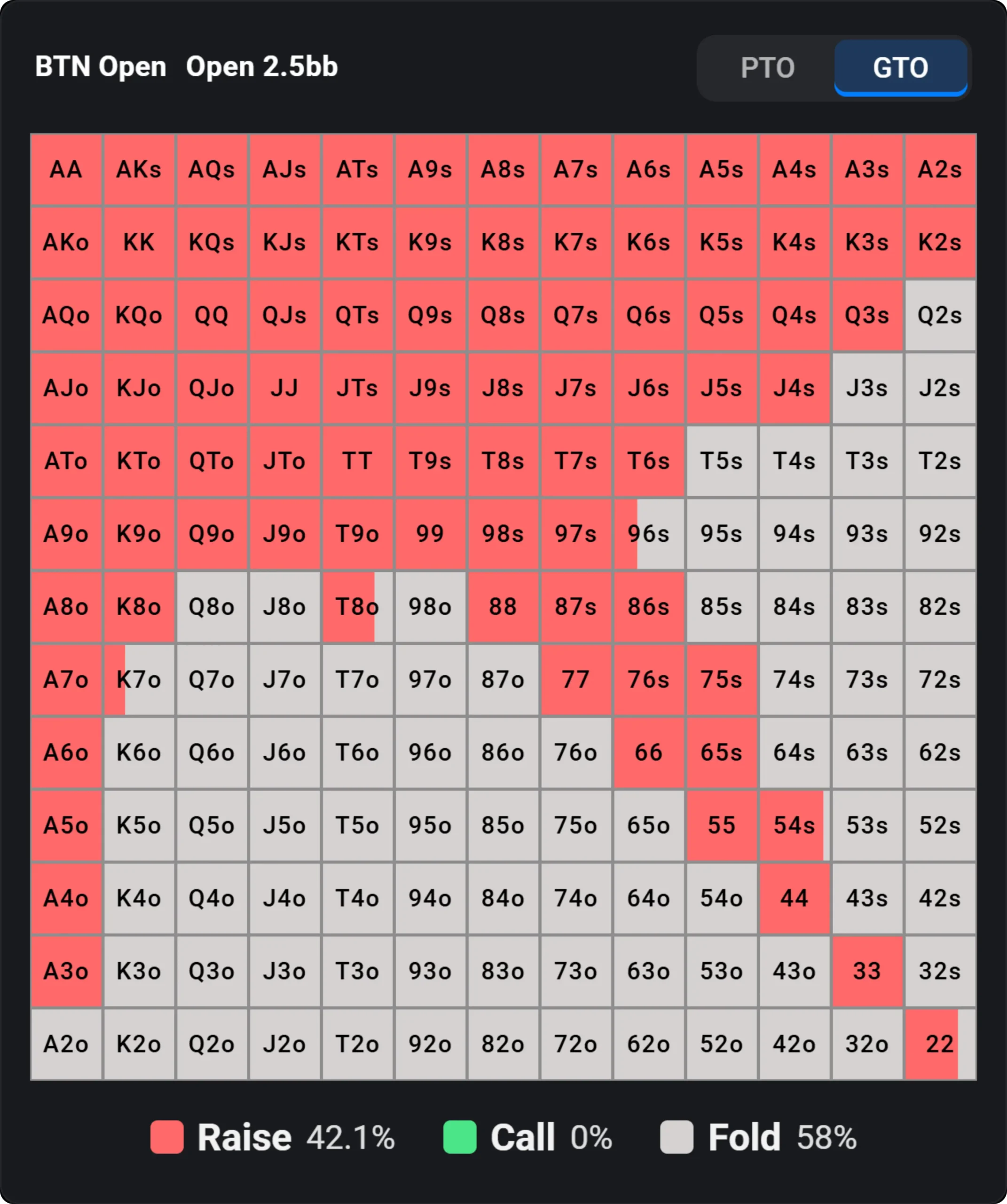
This is a linear button opening range. Hands are chosen from strongest to weakest until the range is complete. All hands are played the same way and very weak hands are excluded. Linear ranges are common preflop, where the main decision is raise or fold and pressure is not created through bet sizing.
Linear betting can also be used as an exploit against opponents who call too wide. However, against disciplined players, betting linearly on later streets often becomes inefficient.
A polarized range contains very strong hands and very weak hands, but few medium-strength hands. A perfectly polarized range has no medium hands at all. Polarized betting means betting with a range made up of strong value hands and bluffs that rarely win by checking. This structure is most common on the river, where no future cards remain.
For example, on the river a player may make a large bet or overbet using only very strong hands and pure bluffs, while checking most medium-strength hands.
This range type is closely linked to minimum defense frequency (MDF). Large bets force the opponent to fold often enough, which allows the betting range to contain many bluffs without giving up value. If you want to understand why bigger bets support more bluffs, read our guide on minimum defense frequency.
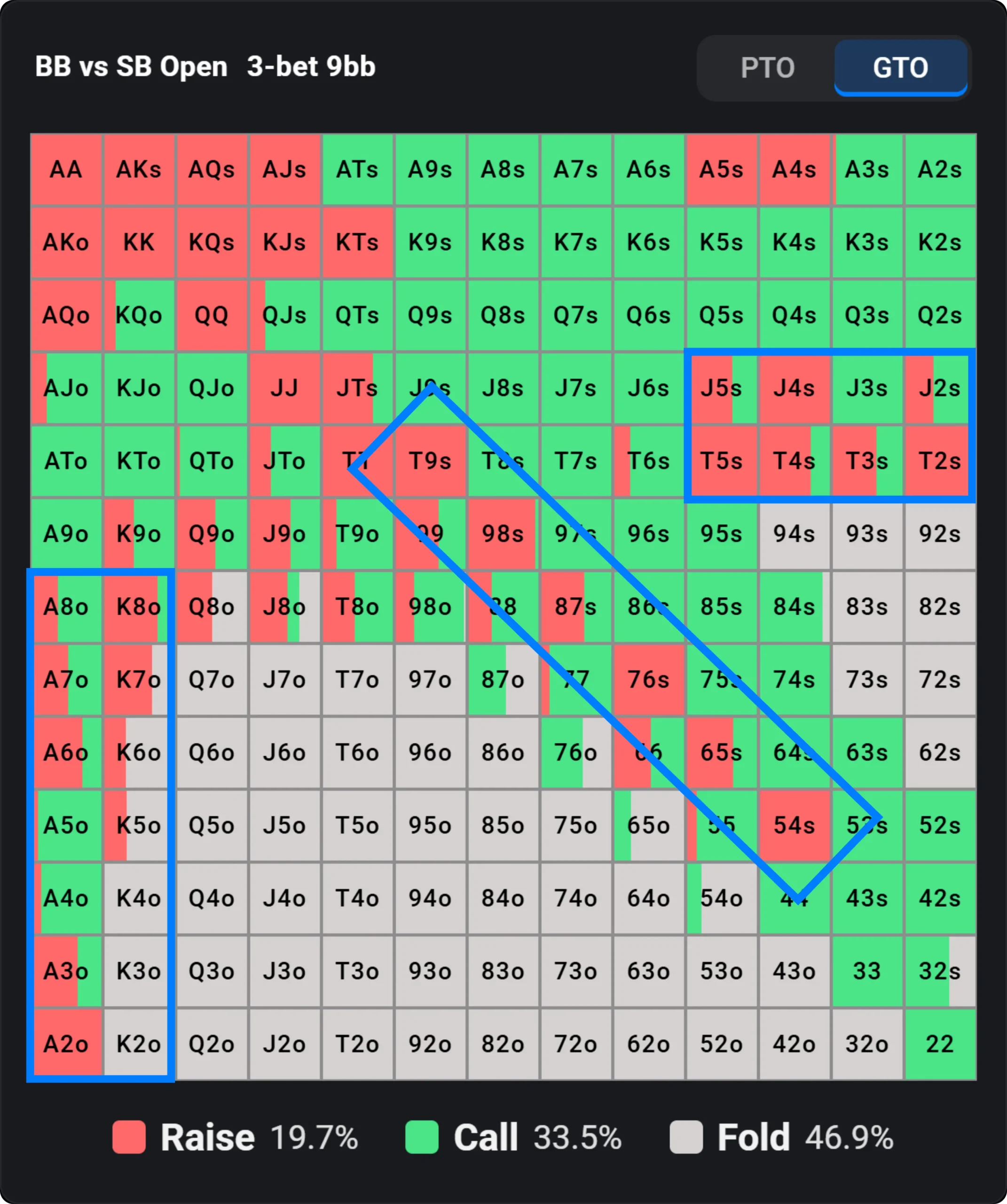
This range is polarized for the big blind facing a small blind raise. The raising range contains strong value hands and weaker bluff hands, which are marked in blue, while many medium-strength hands are played as calls. The strong hands raise to build the pot and the weaker hands rely mainly on fold equity.
Large bets work best when you have a nut advantage, meaning your range contains more of the strongest possible hands than your opponent’s range. When you have the nuts or near-nuts more often, your opponent is put in a difficult position. If they fold too much, your bluffs make money. If they call too much, they lose heavily to your value hands.
There is no easy adjustment for them. This is why polarized big bets are powerful when you hold the nut advantage. Your strongest hands extract maximum value and your weakest hands benefit from increased fold equity.
Medium-strength hands usually make poor large bets. They are not strong enough to get called by worse hands often and not weak enough to function as efficient bluffs. When you bet them big, you often fold out hands you beat and get called by hands that beat you.
Two related but distinct concepts explain why players choose certain bet sizes and frequencies: equity advantage and nut advantage.
Equity advantage, sometimes called range advantage, means your range is stronger on average than your opponent’s range.
Nut advantage refers to which player has more of the strongest possible hands as part of their range on a given board.
Equity advantage mostly affects how often you should bet. Nut advantage mostly affects how big you should bet.
For example, after raising preflop from CO and getting called by the big blind, a board like K♦︎ 9♣︎ 2♠︎ gives the preflop raiser an equity advantage. This supports frequent betting, often with smaller sizes. You can look up this exact situation in the Poker Trainer Odds Calculator to see how the two ranges perform against each other on this board.
On a board like 5♠︎ 4♠︎ 4♦︎, the big blind may have more trips than the preflop raiser. Even if the raiser has many strong hands, the defender may have the nut advantage which changes how large bets can be used. Equity is also much closer between raiser and caller. This spot can also be explored in the Odds Calculator by comparing the two ranges on a paired low board.
A useful rule of thumb is that equity advantage pushes you toward betting more often, while nut advantage pushes you toward betting bigger and less often. When you have both advantages, you often have a strategic choice. You can bet small and often, or bet bigger with a more polarized range.
Which option is best depends on board texture and how equity and nut advantage are distributed across both ranges.
So far we have looked at what happens when you have equity or nut advantage. But just as important is understanding what to do when your opponent has it.
If your opponent has the equity advantage, their range is stronger on average. That means you should usually bet less often. You will do more checking and your betting range should be more selective. When you do bet, it is often with hands that can improve or apply pressure, rather than with thin value.
If your opponent has the nut advantage, they have more of the very strongest hands. This limits how big you can bet. Large bets become risky because your opponent can respond with very strong hands more often. In these spots, you often prefer smaller bets or checking, and you must be careful with medium-strength hands.
If your opponent has both equity and nut advantage, the situation becomes defensive. You will check more frequently, protect your checking range with some strong hands and avoid building big pots with marginal hands. Your strategy becomes more about bluff-catching, pot control and choosing good turn and river cards to continue on.
In short:
Understanding not only when to push your advantage, but also when to slow down, is key to solid range construction.
A condensed range contains many medium-strength hands, with few very strong hands and few very weak hands.
A common example is a small blind calling range versus an early-position open. It may be capped, but it contains many playable hands such as pocket pairs, suited aces, and medium broadways. Bluffing into this type of range can be difficult.
A merged range sits between linear and polarized. It contains strong hands, some medium-strength hands, and some bluffs. Merged betting often uses smaller sizes and is common when a player has an equity advantage but limited nut advantage.
A capped range is a range that rarely contains the strongest possible hands.
An uncapped range can contain the nuts or near-nuts.
Capped ranges often appear when a player takes a passive action earlier in the hand, such as calling instead of raising. By not raising, they remove some strong hands from their range.
Uncapped ranges are common for aggressive players who make big bets, raise or re-raise. Because they can still have the strongest hands, they can apply more pressure.
This difference matters a lot for betting strategy. When you bet against a capped range, your opponent cannot protect themselves with very strong hands. This makes them more vulnerable to large bets and polarized strategies.
When both players have uncapped ranges, large bets become riskier. Neither player can easily force folds, and strategies often shift toward smaller sizes or more checking.
Bluffing in poker becomes much easier to understand when you think in ranges. On earlier streets, bluffs are often semi-bluffs because hands can still improve. By the river, bluffs are usually hands with no showdown value. This is why river betting ranges often become polarized, with value hands and pure bluffs.
Understanding these range types helps you choose the right strategy, adjust your bet sizing, and apply pressure in the right spots. Linearity and polarity exist on a spectrum. Ranges change shape as the hand progresses from preflop to river.
Linear range
A linear range consists of strong to medium-strength hands. It is typically used when you continue with a single action, such as betting or raising with most of your range.
Polarized range
A polarized range includes very strong hands and bluffs. It is commonly used with larger bet sizes to apply pressure while balancing value and bluffs.
Condensed range
A condensed range is made up mostly of medium-strength hands. It is often associated with calling-heavy strategies rather than aggressive betting.
Merged range
A merged range combines strong hands, medium-strength hands, and some bluffs. It is usually played with smaller bet sizes to extract value from a wider range.
Capped range
A capped range cannot contain the strongest possible hands. It is often more defensive and vulnerable to pressure from aggressive opponents.
Uncapped range
An uncapped range can include the strongest hands. This allows for more aggression and makes it easier to apply pressure on opponents.
The goal of range construction is not perfection. It is understanding. When you understand how ranges are built, why certain hands bet and others check and how bet size interacts with range shape, poker becomes more logical and less emotional.
This understanding improves bluffing, value betting, and defense, even if you never think about exact frequencies at the table.
Poker players often ask whether they should play GTO poker or focus on exploitative play. This question comes up a lot and much of the…

Many players see a decent hand and they bet. They see a weak hand and they check. This often leads to decisions that are hard to explain later…