Poker odds explained
Poker odds can feel intimidating at first. For many players, math is the part of poker they want to avoid. But poker odds are not really about being good at math…

How to
get better at poker
Poker is easy to learn, but hard to master. That is part of what makes it fun. If you want to know how to become better at poker, the key is to stop relying on “just playing more” and start improving with a simple system.
Poker can feel confusing because results are not a clear signal. You can make a good decision and still lose and you can make a bad decision and still win. That is why strong players focus on decision quality, not short-term outcomes.
This guide explains a modern and practical way to improve at poker over time. It works for beginners, intermediate players and advanced players. You will learn how to combine playing with studying, reviewing hands and structured poker training so you improve faster and with less frustration.
Before you can improve specific parts of your strategy, you need a base. You need to understand the rules, recognize hand strength and feel comfortable with the flow of a hand.
If you are new, start by learning how to play poker and the basic rules. Then practice poker hand rankings and practice identifying the best hand. After that, explore hands in a poker simulator to understand how hands move from preflop to river.
When the basics feel comfortable, move into strategy. Practice which hands to play preflop in different situations. Practice how board textures change which hands are strong. Learn common hand types, odds and outs and how often your hand wins against an opponent’s range.
If you want a step-by-step path from beginner to intermediate, read the Learn to play poker guide. Once you have this foundation, you are ready to improve faster, because you can set useful goals.
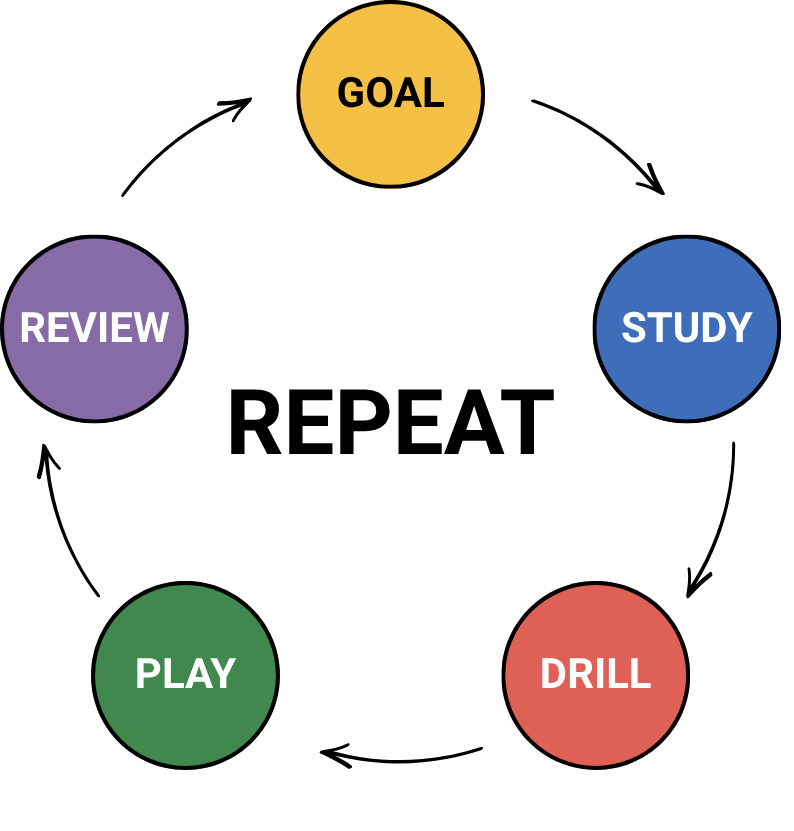
Poker has a slow and unreliable feedback loop when you only play. Variance can hide mistakes for a long time, sometimes forever. The fastest way to improve is to repeat a simple loop: Goal → Study → Drill → Play → Review. This loop keeps you focused and makes progress easier to see.
Pick one clear goal at a time. Small goals work best. Good goals are specific and connected to real situations. For example:
Goal: Improve big blind defense versus small open raises
Goal: Improve 3-betting on the button
Goal: Improve thin value betting on the river
Bad goals are too broad, such as “improve postflop.” Those goals are hard to train and hard to measure.
In general, it is best to focus on one goal at a time and work in a clear time cadence. For most players, a weekly cadence works well. If a goal feels too large to complete in one week, break it down into smaller, achievable goals that each fit into a single loop.
When you have played poker for a while, you are usually aware of many possible areas to improve. The challenge is not finding leaks, but choosing which ones to work on first.
When selecting goals, it helps to think in terms of impact and effort.
Leaks that have a big impact on your win rate and are relatively easy to fix should usually be prioritized. Early on, these are often common preflop spots or very frequent situations, where small improvements add up quickly.
If a leak appears hundreds of times over a large sample, even a small mistake can cost a lot over time. Fixing those spots gives you much more return than working on rare, complex situations.
If you are not sure what to pick, choose the spot that feels most uncomfortable when you play. These are often situations where decisions feel unclear, rushed, or stressful, and they frequently cost money.
If you are a recreational player, it also makes sense to factor in enjoyment. Working on something you find interesting or fun makes it much easier to stay consistent and actually follow the improvement loop.
Study is where you find better answers. Review shows what happened. Study explains why it happened and what the best play is. This is where mistakes turn into clear rules you can actually use.
Start with one theme from your review and keep it narrow. For example:
The goal is not to collect information. The goal is to understand one idea well.
Ask simple questions:
End study with one small takeaway. Write it as one clear sentence you can follow in-game. Study should not feel endless. You are learning one thing at a time so your next drill and play sessions have a clear purpose.
Drill means focused practice with fast feedback. At the table, you might face a tough spot only a few times per session. In training, you can face the same type of spot many times in a short period and learn much faster.
This kind of focused training is often called deliberate practice. It means working on one skill on purpose instead of hoping it improves on its own.
A good drill session is short and focused. Five to fifteen minutes is enough if you are fully present. Scores, levels, and instant feedback also make practice more engaging and help fix poker’s slow feedback loop.
Play means going to the table and applying the same goal. Drills build the skill, but play is where you learn how to apply what you have learnt in real situations. It is often harder than you think. When you play, keep that one goal in mind.
If your goal is connected to big blind defense, pay extra attention every time you need to defend in the big blind. If your goal is river value betting, slow down on rivers and think about which worse hands can call.
Mark hands that feel unclear. Those hands will be used in review.
Review is where experience turns into learning. Start with the hands you marked. Ask simple questions:
If you use a poker tracker, review basic stats to look for patterns. For example:
Use simple tools when helpful. An Odds Calculator can help you check equity and explore how different hands and boards change the result.
For more advanced players, review often ends with a small update to your gameplan. This does not need to be complex. One clearer rule or a small adjustment is enough.
The goal of review is not to judge yourself. It is to decide what to do a little better in the next loop.
One common mistake is to work on something once and then forget it. A better approach is repetition. Review the same spot again tomorrow, then a few days later, then one week later. This is a simple form of spaced repetition. It helps skills stick, especially in spots you often get wrong.
Small, consistent practice beats rare long sessions. Try training to something you already do. For example, do one short drill before you start playing or train for ten minutes at the same time every day.
Training should feel challenging but not overwhelming. If it is too easy, you lose focus. If it is too hard, you guess and do not learn. Adjust difficulty so you can stay engaged and improve steadily.
If you want to become better at poker, you need a system that helps you improve consistently over time. Build a foundation first. Then repeat the loop:
Goal → Study → Drill → Play → Review.
It is simple, but it works. It keeps learning focused, makes progress easier to see, and helps you improve much faster than playing on autopilot.
Poker odds can feel intimidating at first. For many players, math is the part of poker they want to avoid. But poker odds are not really about being good at math…

Most poker players want to know their poker win rate as quickly as possible. This is natural. You want to know if your results are mostly…